





Dodge Ram Truck Bed Size Guide for Long Island Buyers
You’re parked outside Home Depot on Sunrise Highway, looking at the materials you need and the SUV you’d rather not load them into. A pickup would solve that problem, but now you’re wondering whether the shorter RAM bed will handle your projects or leave you wishing you’d bought more truck. That’s the right question to ask before choosing paint, wheels, or an equipment package.
Table of Contents
- Why Bed Size Matters More Than Most Buyers Expect
- How RAM Measures a Truck Bed
- RAM 1500 Bed Options at a Glance
- Matching Cab and Bed Across 1500, 2500, and 3500
- Payload, Towing, and What Bed Volume Really Buys You
- Tonneau Covers, Racks, and Cargo Fit in the Real World
- Fuel Economy and Affordability by Engine and Drivetrain
Why Bed Size Matters More Than Most Buyers Expect
Your truck has to fit the rest of your week, not just the load waiting outside the store. That means parking for the Babylon train station, backing into your driveway in Massapequa, and carrying fishing equipment when you take a jon boat toward Captree. Buy for the cargo you carry regularly and the places you park daily.
For the 2026 RAM 1500, the primary choices are a 5-foot-7-inch bed and a 6-foot-4-inch bed. The Quad Cab pairs with the longer box, while the Crew Cab can be configured with either, according to MotorTrend’s RAM 1500 model overview.
That choice deserves more attention than buyers sometimes give it. A bed that’s inconvenient for your regular equipment becomes a recurring loading problem. A truck that feels unnecessarily cumbersome in your usual parking spaces becomes a different kind of daily frustration.
Start With Your Ordinary Week
Think about what you need the truck to do:
- Weekend cargo: Garden supplies, beach equipment, bicycles, and the occasional furniture pickup.
- Work equipment: Tool cases, ladders, landscaping equipment, and materials you can’t leave behind.
- Daily transportation: Commuting, school pickups, grocery stops, and parking around Amityville, Lindenhurst, and Copiague.
My recommendation for a buyer whose truck will mainly handle commuting and household projects is straightforward: start with the shorter bed. Move to the longer box when you can identify equipment that needs the additional floor space.
Don’t buy a longer truck for an imaginary project. Don’t buy a shorter truck when your actual work equipment already needs more room.
If you’re also considering a new Grand Cherokee, Wrangler, or Durango, ask whether you need an open cargo bed at all. I’d keep those models in the conversation when passenger transportation and enclosed belongings matter more than hauling dirty or awkward materials.
Searching for Dodge Ram truck bed size should lead to a practical decision, not just the biggest specification. The right pickup accommodates your usual load without making every other trip feel like a compromise.
How RAM Measures a Truck Bed
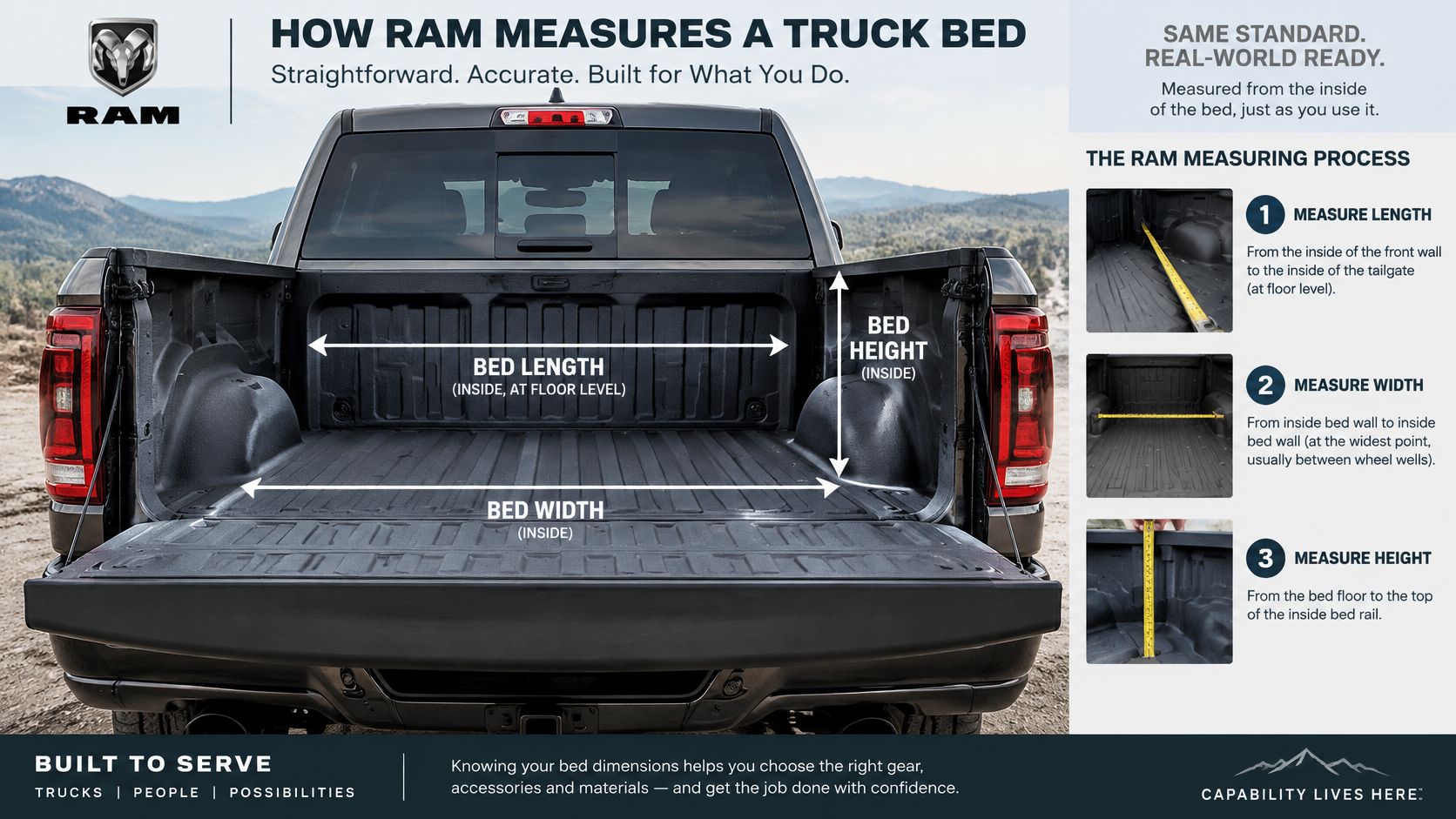
Nominal bed length isn’t the complete cargo footprint. Before deciding that a piece of equipment fits, check its length, width, height, and loading path. An object can clear the bed walls yet still interfere with a wheelhouse or the tailgate opening.
Measure the Space Your Cargo Occupies
Use a tape measure and record the dimensions at the actual contact points:
- Floor length: Measure along the floor from the front bulkhead to the inside of the closed tailgate. Don’t substitute a measurement along the upper rail.
- Wall-to-wall width: Check the broadest interior span, then compare it with the widest part of your equipment.
- Between-wheelhouse width: Measure the narrower floor area where a box, machine, or sheet material will rest.
- Bed depth: Measure from the floor toward the rail, especially if you intend to close a cover over the load.
- Tailgate opening: Check the entry point, not just the space available once an object is inside.
Published specifications identify approximately 51.0 inches between the wheelhouses, 66.4 inches wall to wall, and a 60.0-inch tailgate opening in representative RAM 1500 configurations, as listed in RAM’s published specification brochure.
There’s an important distinction for 4-by-8 sheet material: those dimensions do not support the claim that a standard sheet is too wide to sit between the wheelhouses. Its width fits that clearance; its length is the problem in the shorter boxes. Don’t confuse insufficient bed length with insufficient floor width.
Treat Cargo Volume as a Comparison Tool
SAE-rated cargo volume helps you compare the boxes, but it doesn’t guarantee that a particular machine or storage chest fits. A large volume can still have the wrong shape for your equipment.
Liners, organizers, cover hardware, and other accessories can change the usable space or obstruct a loading path. Measure the truck as you intend to equip it, rather than relying exclusively on an empty-bed specification.
For a West Babylon contractor, that means checking the actual tool cases. For a recreational buyer, bring the bicycle carrier dimensions or kayak support requirements. Cargo measurements beat assumptions, especially when you’re buying accessories at the same time as the truck.
RAM 1500 Bed Options at a Glance
Choose the short box for a pickup that primarily supports suburban life. Choose the longer box when hauling is a regular responsibility. Neither is automatically the smarter purchase, but your normal cargo should make the decision fairly clear.
The RAM 1500 Bed Dimensions Compared table uses Edmunds’ published RAM 1500 specifications. On those measurements, the longer box adds 8.9 inches of floor length and approximately 7.5 cubic feet, or roughly 14 percent more measured cargo volume.
| Bed Length | Floor Length | Wall-to-Wall Width | Between Wheelhouses | Bed Depth | Cargo Volume |
|---|---|---|---|---|---|
| 5 feet 7 inches | 67.4 inches | 66.4 inches | 51.0 inches | Approximately 21.4 inches | Approximately 53.8 cubic feet |
| 6 feet 4 inches | 76.3 inches | 66.4 inches | 51.0 inches | Approximately 21.5 inches | Approximately 61.3 cubic feet |
The Short Box for Household Utility
I’d recommend the shorter box to a Massapequa Park buyer who wants a commuter during the week and a project vehicle on weekends. Bags of mulch, portable tools, coolers, and ordinary household purchases make a different demand on a truck than equipment that must remain loaded for work.
The short box also makes sense when you’re willing to use a properly selected carrier for recreational equipment. Don’t assume every bicycle needs to stand entirely inside the closed bed. Choose the transport system first, then evaluate its footprint.
There’s a limit to that flexibility. If your normal loading routine involves dismantling equipment or repeatedly unloading unrelated items to reach a tool, you haven’t necessarily saved yourself anything by choosing the shorter configuration.
The Longer Box for Recurring Loads
The longer box is my recommendation for buyers who routinely combine equipment and materials. Think of a Lindenhurst remodeler carrying tool cases alongside job supplies, or an outdoor enthusiast loading bulky recreational gear rather than just a cooler and folding chairs.
The useful benefit isn’t merely more space for loose cargo. It’s more freedom to position equipment, separate items, and maintain access to what you need during the day.
- Choose shorter: Your workday mostly involves driving, and hauling is occasional.
- Choose longer: You can name equipment that regularly consumes the available floor.
- Test before deciding: Your cargo is irregularly shaped, expensive, or difficult to reposition.
Don’t assume a longer bed solves a width problem. As the comparison shows, the additional room is primarily length. A broad machine still needs its own fit check.
Matching Cab and Bed Across 1500, 2500, and 3500
Choose the cab first, the bed second, and the trim third. That order keeps you focused on the people and equipment the truck must accommodate before you spend time comparing appearance packages.
For a new RAM 1500, use the cab-and-bed pairings identified earlier as your starting point. If you need a Crew Cab, compare the available box choices within that cab. If you prefer a Quad Cab, recognize that its box pairing already narrows the decision.
Don’t treat a bed-size result from a different model year or truck generation as a current factory-order promise. Regular-cab references can lead shoppers toward long-box configurations, but they aren’t evidence that the current RAM 1500 offers the same combination.
When a Heavy-Duty Box Makes Sense
For the RAM 2500 and RAM 3500, published bed choices expand to 6 feet 4 inches and 8 feet, with approximately 57.5 and 74.7 cubic feet of cargo volume respectively. The long heavy-duty box therefore provides nearly 30 percent more volume, according to ArmorThane’s truck-bed dimensions reference.
That gives you a useful shopping framework:
| Your Main Priority | Where I’d Start | What Must Be Verified |
|---|---|---|
| Commuting and occasional household hauling | RAM 1500 | Cargo fit and everyday parking comfort |
| Work equipment plus personal use | Longer-box RAM 1500 or RAM 2500 | Actual load requirements |
| Long equipment and demanding hauling needs | RAM 2500 or RAM 3500 long-box configuration | Cab availability, ratings, and equipment compatibility |
Don’t move into a heavy-duty truck just because the box sounds impressive. Move there because the dimensions and capability requirements of your work justify it.
For a contractor traveling between Amityville and Farmingdale, a long box may be useful enough to accept its parking compromises. For someone commuting with an otherwise empty bed, I’d question that purchase.
Where Big Horn and Lone Star Belong
If you’re comparing RAM 1500 Big Horn and Lone Star listings, keep the cab, box, engine, and drivetrain visible beside the trim name. Those details tell you whether you’re comparing equivalent trucks.
My advice across all RAM 1500 trims is the same: settle the working configuration before choosing cabin upgrades. A premium interior won’t make an unsuitable bed fit your tools, and a value-focused trim won’t help if the truck lacks the configuration you need.
For heavy-duty shopping, ask for the actual build information identifying which cab and trim combinations support the long box. Don’t accept a model-family description as confirmation that every configuration is available.
Payload, Towing, and What Bed Volume Really Buys You
A bed full of folding chairs and a bed full of stone are completely different buying problems. They might occupy similar space, but you should evaluate them differently. Volume describes room. Payload describes carrying weight. Towing describes the trailer load.
For heavy materials, start with weight rather than bed dimensions. Soil, pavers, a salt spreader, or a slide-in camper can make carrying capability the deciding factor long before you use every available part of the box.
Separate the Questions Before Choosing a Truck
- Cargo volume: Will the objects physically fit, and can you secure them properly?
- Payload: Can the exact truck carry the planned people, equipment, accessories, and applicable hitch load?
- Towing: Can the exact truck safely handle the intended loaded trailer and hitch arrangement?
For a homeowner in Copiague buying landscaping materials, I’d ask the supplier for the load’s weight before discussing how much bed space remains. Don’t use the height of a pile as a substitute for a weight check.
For someone taking a boat toward Captree, I’d ask about the loaded trailer and everything else traveling in the pickup. The boat isn’t the whole calculation when passengers, coolers, and fishing equipment are coming too.
Buying rule: Match the truck to the complete loaded trip, not the empty trailer or the empty bed.
Check the Actual New Truck
Ask to review the truck’s certification and loading information alongside the manufacturer’s configuration-specific towing documentation. Engine, cab, drivetrain, installed equipment, and hitch setup all belong in that conversation.
Don’t borrow a rating from a different truck because it wears the same badge. A headline capability claim isn’t a substitute for checking the vehicle you’re considering.
For a slide-in camper, get the camper manufacturer’s fit and loaded-weight requirements before selecting the pickup. For a work truck, include equipment that will stay aboard instead of mentally treating it as temporary cargo.
I wouldn’t recommend choosing between a RAM 2500 and RAM 3500 from bed volume alone. Establish the load requirements, verify the appropriate ratings, and then choose the box that accommodates the equipment. More empty space is useful only when the truck is suitable for what you’ll put in it.
Tonneau Covers, Racks, and Cargo Fit in the Real World
Buy accessories around a loading plan, not around a product photograph. A cover, toolbox, and rack can each seem sensible individually, then interfere with one another when installed together.
The same truck also has to remain practical when you stop during your commute or head out for the weekend.
Choose Compatible Equipment Together
A tonneau cover should match the exact model year, bed configuration, and relevant factory equipment. Don’t order solely from the nominal bed-length description. Confirm how it mounts and whether it can operate with your planned rack or toolbox.
A cross-bed toolbox deserves a physical fit check. Its body, mounting arrangement, and lid movement matter, especially if you want to carry tall equipment beside it or use a cover.
- Check the opening motion: Make sure the toolbox lid and cover can move without interference.
- Measure the remaining floor: Compare the space behind the toolbox with your longest routine load.
- Confirm rack compatibility: Ask whether the rack and cover use conflicting mounting points.
- Plan access: Make sure you can reach frequently used tools without unloading recreational equipment.
For a buyer carrying ladders to jobs around West Babylon, I’d prioritize the ladder transport arrangement before selecting a cover. For weekend bicycles or kayaks, I’d work backward from a carrier approved for that equipment and truck setup.
Support Sheet Materials Properly
Use the sheet-width and bed-length distinction established earlier when planning material transport. Don’t angle a sheet against the cab because it seems to fit that way. Cargo needs appropriate support and restraint, not just an available position.
Depending on the material and equipment, a suitable plan could involve an approved raised support arrangement, a properly supported open-tailgate load, or a trailer. Check the truck and accessory manufacturers’ loading guidance before choosing among them.
A red flag identifies an overhanging load. It doesn’t support the material or secure it to the truck.
Check applicable New York requirements for overhang, marking, lighting, and visibility before driving. Keep required lights and the plate unobstructed, and don’t let a purchase at the building-supply counter become an improvised transport experiment.
Bring accessory model information and cargo dimensions when shopping for the truck. That lets you evaluate a complete setup before committing to a bed that only works when it’s empty.
Fuel Economy and Affordability by Engine and Drivetrain
Don’t choose your engine from bed length alone. Buy enough capability for the job, then compare the cost of the configurations that satisfy it. A truck that fits the driveway but strains the household budget isn’t the right match.
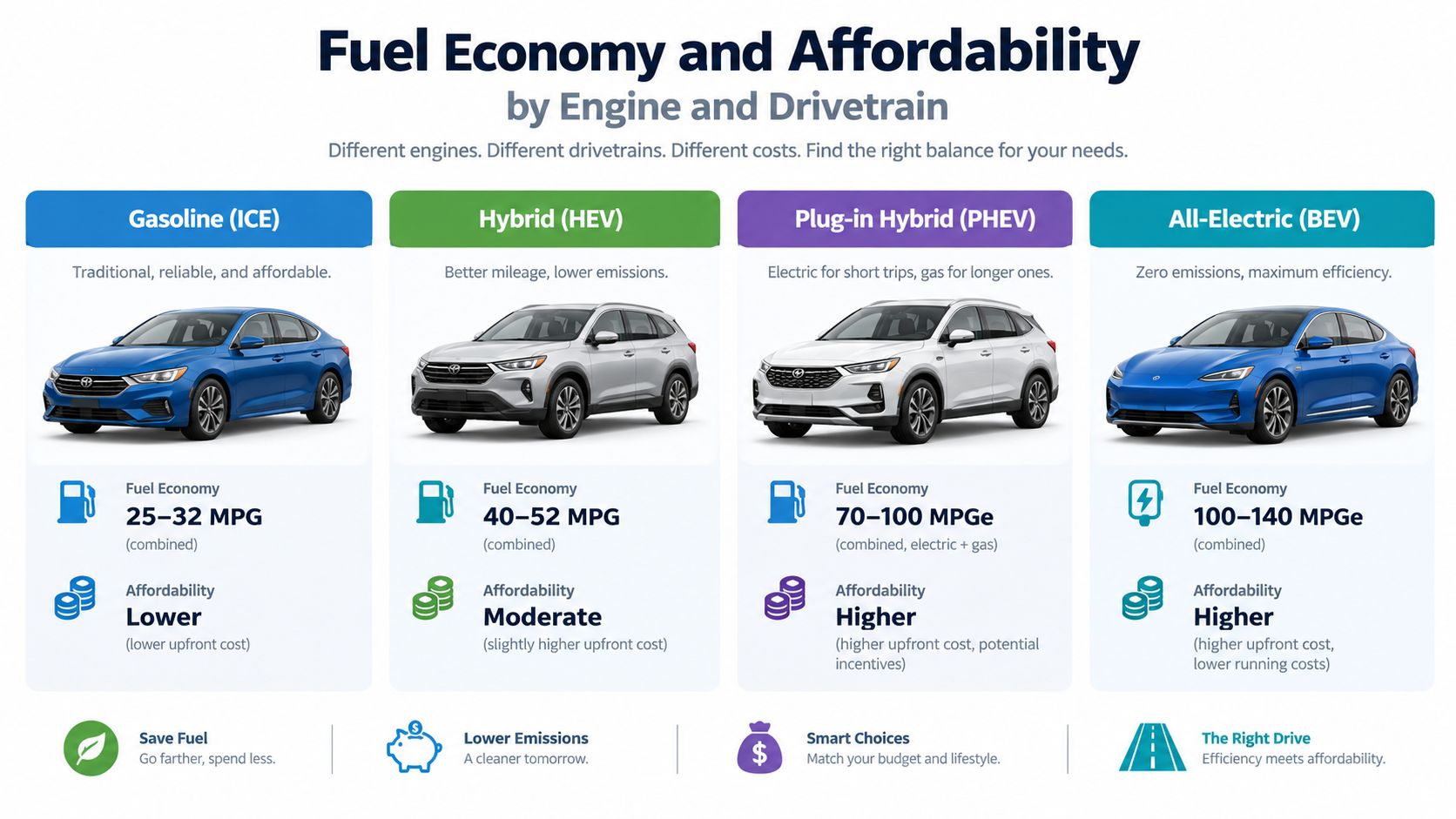
For a Massapequa-to-Melville commute, I’d pay close attention to engine and drivetrain before paying for performance you rarely use. The broader vehicle comparison below isn’t a RAM-specific pricing or fuel-economy estimate.
Compare the Published Ratings
Published ratings put the 3.6-liter V6 with rear-wheel drive as high as 20 mpg city, 25 mpg highway, and 22 mpg combined. The four-wheel-drive V6 is approximately 19 city, 24 highway, and 21 combined; the standard-output Hurricane reaches as much as 21 combined in two-wheel-drive form, while the high-output Hurricane returns about 17 combined in most four-wheel-drive applications, according to Cars.com’s RAM 1500 pricing and configuration overview.
My recommendation is to start with the V6 if your verified hauling requirements allow it and commuting dominates your use. Consider the standard-output Hurricane when its capability suits your planned loads. Choose the high-output engine because you want and can budget for that performance, not because you assume every pickup needs it.
Treat four-wheel drive as a deliberate equipment decision. Compare its usefulness for your driving with the published efficiency difference rather than checking the option automatically.
Calculate Your Own Monthly Fuel Budget
An honest monthly dollar estimate needs your mileage and the fuel price you expect to pay. Without those inputs, a neat-looking payment comparison would be guesswork.
Use this calculation:
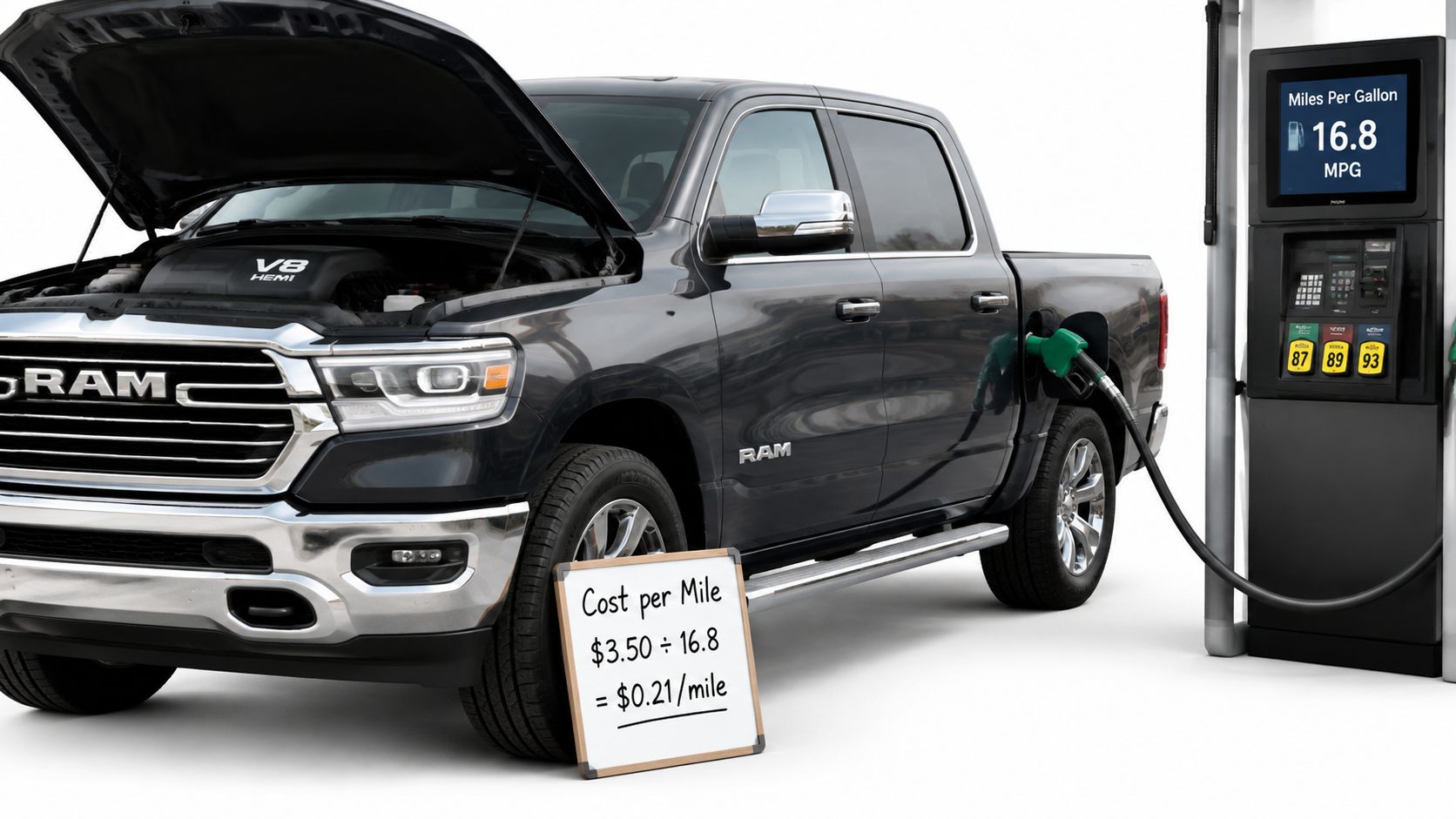
Monthly miles ÷ expected mpg × fuel price per gallon = estimated monthly fuel spending.
For commuting, don’t assume highway ratings describe a trip filled with local streets and congestion. Use an estimate that reflects your actual route, and leave room in the budget for recreational trips and loaded driving.
For Big Horn, Lone Star, and other RAM 1500 trims, compare written purchase figures for equivalent configurations. Review the out-the-door price, financing terms, required down payment, and total amount paid, not just the monthly payment.
- Keep useful equipment: Prioritize the bed, cab, and capability your routine requires.
- Question optional spending: Remove upgrades you wouldn’t miss after the first week.
- Compare complete ownership budgets: Include financing, fuel, insurance, and planned cargo equipment.
If you’re cross-shopping a Grand Cherokee, Wrangler, or Durango, run the same affordability calculation using each exact vehicle’s information. Don’t assume an SUV or pickup will automatically cost less to live with. Choose the vehicle that meets the need without paying for a different lifestyle.
Security Dodge Chrysler Jeep RAM offers new-vehicle shopping and auto-loan options for buyers comparing a RAM truck with a Grand Cherokee, Wrangler, or Durango. Bring your cargo measurements, trailer information, and monthly budget when you visit Security Dodge Chrysler Jeep RAM in Amityville, and ask to compare the cab, bed, and engine configurations that fit how you will use your new vehicle.
0 comment(s) so far on Dodge Ram Truck Bed Size Guide for Long Island Buyers