




Dodge Service Department Guide for Long Island Drivers
You’re heading out from Amityville toward the South Shore when the check-engine light appears on your Grand Cherokee. Or you’re preparing a RAM 1500 for a trailer run to Montauk and discover the trailer brake controller isn’t communicating. At that point, you don’t need a generic list of oil changes. You need a service department that can identify the fault, access the right factory information, document the repair, and tell you what happens next.
A proper Dodge service department is a technical operation, not just a waiting room with lifts. For Long Island owners of the Grand Cherokee, Wrangler, RAM 1500, and Durango, the right choice comes down to diagnostic capability, repair-order discipline, parts access, and clear communication.
Table of Contents
- What a Dodge Service Department Near Amityville Actually Does
- Models Served at Security Dodge in Amityville
- Core Service Categories Offered
- How the Service Department Operates Day to Day
- Scheduling Your Service Appointment Step by Step
- What Happens During a Typical Service Visit
- Handling Repairs, Delays, and Price Transparency
- Service Schedules for Severe Use on Long Island
- Quick Reference for Hours, Contact, and Specials
- Common Questions Before Your First Visit
What a Dodge Service Department Near Amityville Actually Does
A factory-authorized Dodge service department connects your vehicle to the manufacturer’s repair systems. Technicians use Stellantis service information, OEM diagnostic equipment such as wiTECH 2.0, and manufacturer-approved procedures to investigate faults that a general repair shop may not be equipped to address.
That matters when the repair involves a software update, module programming, a recall, or a driver-assistance calibration. A technician may need to scan several control modules, compare live data with factory specifications, flash a replacement module, or recalibrate a camera after windshield or suspension work. Those jobs require more than replacing a part and clearing a warning light.
What happens behind the advisor’s desk
The service advisor starts by turning your concern into a repair order. The write-up should capture the exact symptom, when it occurs, warning messages, recent repairs, mileage, and how the vehicle is used. That detail gives the technician a direction instead of a vague instruction such as “check noise.”
The department then coordinates several functions:
- Factory diagnostics: Technicians use OEM scan tools and service information to test drivability, electrical, transmission, and emissions concerns.
- Warranty and recall processing: The team checks eligibility, follows required procedures, and records the evidence needed for a manufacturer claim.
- Mopar parts sourcing: Parts staff identify the correct component by VIN, trim, engine, drivetrain, and production configuration.
- Module programming: Technicians can perform applicable software flashes, control-module setup, and calibration procedures.
- Inspection and communication: Advisors relay findings, estimates, approval requests, and repair status before additional work begins.
The difference from an independent shop isn’t that independent technicians can’t perform quality work. The difference is the department’s direct connection to Stellantis procedures, warranty rules, OEM parts channels, and model-specific diagnostic information.
Practical rule: If the concern involves a warning light, a software issue, an electronic module, a recall, or an advanced driver-assistance system, ask whether the shop can perform the required factory scan and programming procedure before booking.
For drivers in Amityville, Lindenhurst, Massapequa, Farmingdale, Babylon, and nearby Long Island communities, that capability is especially useful when a routine-looking concern affects towing, four-wheel drive, emissions compliance, or vehicle safety.
Models Served at Security Dodge in Amityville
A Dodge, Jeep, or RAM vehicle used on Long Island needs service based on its drivetrain, workload, and environment. A Wrangler driven through beach sand has different inspection needs from a Grand Cherokee used for commuting. A RAM 1500 towing from the South Shore places greater demands on transmission behavior, cooling, axles, and trailer equipment.
The Grand Cherokee, including the 4xe plug-in hybrid, requires procedures matched to its exact configuration. Service planning may include air suspension calibration, Quadra-Trac transfer case work, hybrid-system procedures, and engine-specific maintenance. Owners of models with the 5.7L Hemi should ask the advisor to confirm the applicable valve-lash inspection or adjustment requirements for that year and configuration.
For the Wrangler, inspect the four-wheel-drive system, axles, steering, and suspension closely. Dana 44 fluid condition, sway bar links, ball joints, and transfer-case operation deserve extra attention after off-road driving, beach use, standing water, or rough access roads. Salt exposure also warrants a careful underbody inspection.
The RAM 1500 shifts the focus toward transmission operation, gear-oil specifications, towing equipment, and electrical programming. For a torque-converter shudder concern, the technician should verify the correct diagnostic procedure and check whether a service bulletin applies. The truck’s 3.21 or 3.92 axle ratio also determines the correct gear-oil specification. Trailer brake controller programming should be checked after towing equipment changes or communication problems.
The Durango combines SUV utility with significant drivetrain and cooling demands. Older pre-2014 models may need attention to the NAG1, also identified as the W5A580, transmission. On 3.6L Pentastar vehicles, coolant or oxygen-sensor work should follow the actual symptoms and diagnostic results rather than a generic parts list.
| Model | Engine/Drive | Key Service Priorities |
|---|---|---|
| Grand Cherokee | V6, 5.7L Hemi, or 4xe plug-in hybrid with available four-wheel drive | Air suspension calibration, Quadra-Trac service, hybrid-system procedures, engine-specific inspections |
| Wrangler | Multiple engine choices with selectable four-wheel drive | Dana 44 axle fluids, transfer-case engagement, ball joints, sway bar links, sand and salt inspection |
| RAM 1500 | V6, Hemi, EcoDiesel, or eTorque configurations with rear- or four-wheel drive | Transmission diagnosis, axle-ratio fluid specifications, trailer brake programming, towing inspection |
| Durango | V6 or performance-oriented V8 configurations | Cooling-system checks, transmission service by year, brake and suspension inspection, oxygen-sensor diagnostics |
Core Service Categories Offered
A first visit usually begins with routine maintenance, but the bay can handle far more than an oil change. The best way to judge the operation is to look at the actual work categories and the tools behind them.
Start with maintenance that prevents larger repairs
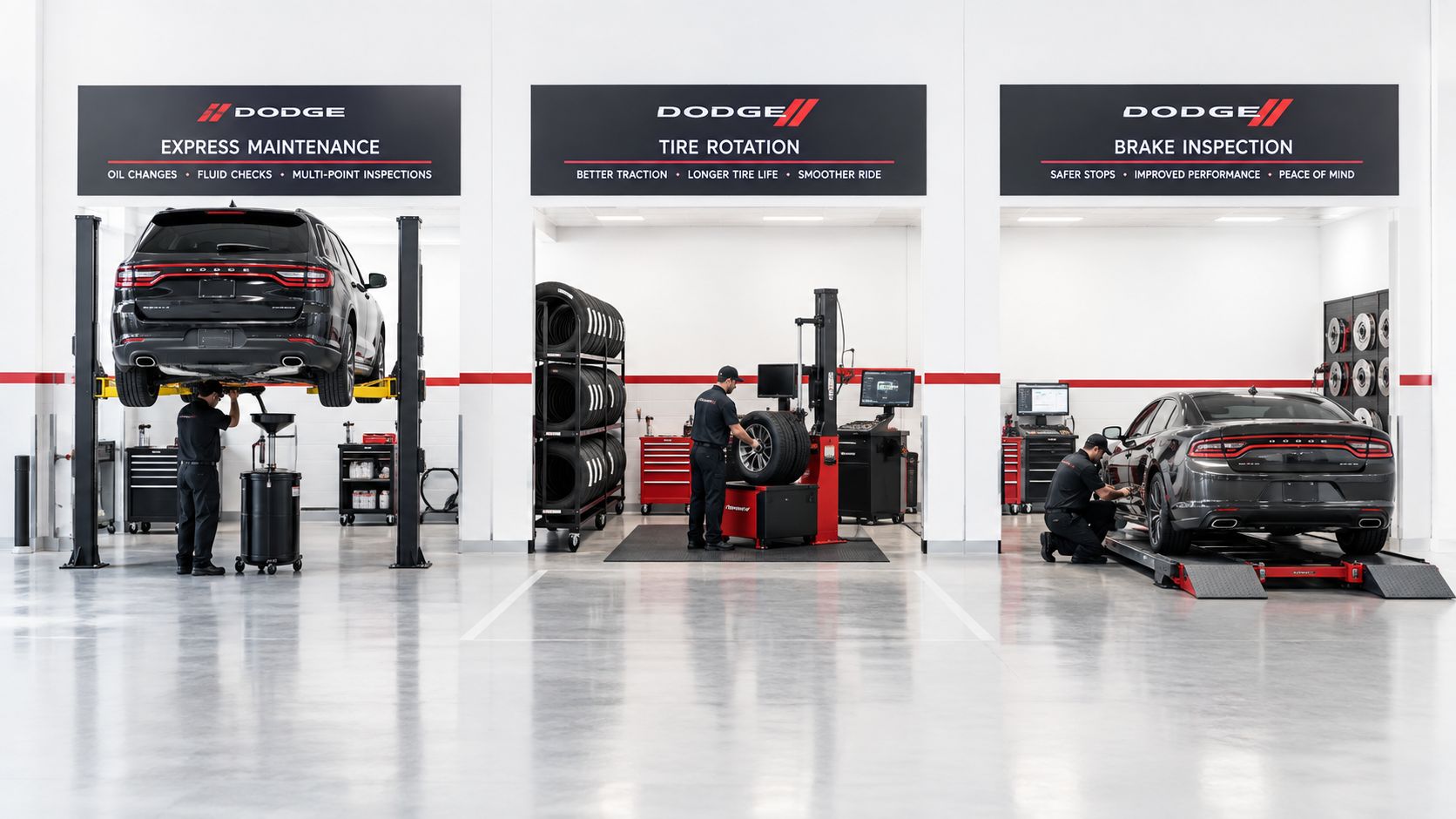
Express maintenance commonly includes oil and filter replacement, tire rotation, fluid checks, a multi-point inspection, and battery testing. A Midtronics battery tester measures battery condition more accurately than a simple voltage reading, which helps identify a weak battery before it leaves you stranded after a cold start or long period of sitting.
Brake work ranges from pad replacement to rotor, caliper, and hydraulic repairs. RAM 1500 and Durango models with larger front braking systems need proper measurement of pad thickness, rotor condition, caliper operation, and brake-fluid condition rather than a quick visual glance.
Tires, alignment, and electronic systems
Tire service should include the correct OEM-specification fitment, valve-stem inspection, TPMS sensor programming, and balancing. Road-force balancing can identify a tire or wheel assembly that appears balanced on a conventional machine but still produces a highway vibration.
Alignment work requires more than adjusting the front wheels. A Hunter HawkEye Elite system can measure all four wheels, which matters for a Wrangler with suspension changes or a RAM 1500 that has developed uneven tire wear. The technician should explain whether the problem comes from alignment, worn steering components, tire construction, or ride-height changes.
Diagnostic work may involve drivability, check-engine lights, transmission adaptive resets, electrical faults, and module flashing. Higher-cost repairs can include HVAC systems, suspension components, timing-chain work, and Stellantis warranty or recall repairs. The advisor should separate confirmed repairs from recommended maintenance so you know what requires immediate approval.
Ask before authorizing: Is the proposed repair based on a measured test result, a visible failure, a factory procedure, or a preventive recommendation?
How the Service Department Operates Day to Day
A busy Dodge service department operates more like a production floor than a passive waiting area. Advisors triage vehicles, technicians work through assigned repair orders, parts staff locate components, and dispatchers manage the sequence so a diagnostic vehicle doesn’t block a scheduled maintenance bay.
The financial scale explains why workflow matters. The NADA 2025 dealership profile reported $164.6 billion in service and parts sales across franchised new-vehicle dealerships. It also reported average service and parts revenue of $9,687,942 per dealership, 8,109 repair orders in the first half of 2025, an average mechanical labor rate of $179, and average service and parts sales of $470 per customer repair order.
Those figures describe an industry-wide operation, not a promise about one store. They do show why appointment availability, parts coordination, technician dispatch, and advisor communication have a direct effect on your experience.
Why throughput affects your appointment
The Cox Automotive ownership study reported that average dealership service and parts operations generated $9.23 million in annual revenue, with revenue growth of 33% since 2018. The same analysis estimated that vehicles in operation in the United States reached nearly 299 million, while dealership share of the total vehicle service market declined from 33% to 29%.
Service absorption is another useful management measure. Industry fixed-operations guidance places average absorption around the mid-60% range, with top-performing stores commonly benchmarked at 80% or higher, best-in-class operations at 95% or higher, and a practical target of 100% or more to cover dealership overhead through service and parts gross profit.
For you, that translates into a simple recommendation. Book routine work early, describe diagnostic symptoms precisely, and ask whether your vehicle needs a dedicated diagnostic appointment rather than a quick-service slot.
Scheduling Your Service Appointment Step by Step
A good appointment starts before you open the scheduler. Gather the vehicle identification number, current mileage, service history, and a short description of the concern. Write down whether the issue happens during startup, acceleration, braking, turning, towing, highway driving, or cold weather.
Four steps that prevent confusion
- Describe the symptom, not just the suspected repair. “The truck shudders while towing at steady speed” gives the technician more useful direction than “I need a transmission.”
- Ask the advisor to check the VIN. The advisor can identify applicable recalls, campaigns, warranty coverage, and model-specific procedures before the visit.
- Choose the right visit type. A wait-in maintenance appointment may work for basic service. A diagnostic concern, software issue, or warranty repair may require drop-off time.
- Confirm the approval process. Ask how estimates are delivered, whether text or phone approval is available, and how the department handles work that requires a second visit.
Plan transportation before drop-off
Ask about shuttle availability, early-bird drop-off, and loaner options for longer warranty repairs. Don’t assume a vehicle will be ready at a precise hour when the technician hasn’t completed diagnosis. A time window is more realistic because parts availability, testing, and manufacturer authorization can change the repair path.
Bring your key, locking-wheel-nut key, registration details if requested, and any relevant warranty paperwork. Remove personal items from the cabin, especially when the vehicle may need a road test or interior diagnostic work.
For a RAM 1500, Wrangler, Grand Cherokee, or Durango, tell the advisor about aftermarket wheels, suspension changes, towing equipment, performance parts, and recent modifications. Those details can affect alignment readings, warning lights, warranty evaluation, and the technician’s testing sequence.
What Happens During a Typical Service Visit
The service advisor creates the record that controls the visit. The repair order should identify the vehicle, mileage, customer complaint, requested work, authorized services, parts, labor, inspection results, and technician sign-off. Treat it as more than paperwork. It’s the documented chain connecting your concern to the department’s diagnosis and final repair.
The first inspection usually covers brakes, tires, fluids, battery condition, lights, and visible underbody components. Long Island driving adds its own concerns, including road salt, pothole impacts, standing water, and sand near beach access roads. A technician may find a safety issue during a routine oil service, but the advisor should separate that finding from the originally requested work.
The diagnostic and approval sequence
For a warning light, noise, vibration, or drivability complaint, the technician may scan the vehicle, review live data, perform circuit tests, inspect mechanical components, and complete a road test. The advisor should contact you with the findings before adding non-authorized repairs.
A complete update should answer four questions:
- What failed: Identify the component or system supported by testing.
- Why it failed: Explain the cause when the technician can establish it.
- What repair is recommended: List parts, labor, programming, calibration, or additional testing.
- What happens if you wait: Describe the safety, drivability, reliability, or convenience consequence without using pressure.
Warranty repair orders require especially careful documentation. OEM warranty compliance guidance emphasizes diagnostic notes, scan data, photos, test results, correct labor-operation codes, and the 3C structure, Customer Complaint, Cause, and Correction. That structure helps the department support a claim and gives you a clearer record of what the technician found.
At pickup, review the final invoice line by line. Confirm the repair, parts, labor, declined recommendations, warranty coverage, and any future follow-up. If the vehicle needs another visit, ask the advisor to document the next diagnostic step before you leave.
Handling Repairs, Delays, and Price Transparency
A Dodge service department earns trust when a repair becomes difficult, not when an oil change goes smoothly. Customer frustration often centers on unresolved problems, unavailable parts, long service times, and unclear charges. The 2025 J.D. Power U.S. Customer Service Index study reported that 30% of dissatisfied customers said the work didn’t fix the problem, while 28% cited unavailable parts. It also reported that 45% of dealership service customers experienced at least one frustration, including 24% who cited longer-than-expected service times and 13% who said it was difficult to find out what the dealership charges.
Those findings make direct questions reasonable. Ask how the department handles a repeat concern, whether the original repair order remains connected to the new visit, and whether the advisor will open a case with Stellantis technical support when normal diagnostic steps don’t resolve the issue.
The response should be procedural
A well-run department should:
- Document the repeat concern: Record what was repaired, when the symptom returned, and the conditions that reproduce it.
- Escalate appropriately: Contact technical support and involve a field engineer when the repair requires higher-level guidance.
- Explain parts delays: Identify the backordered component, current availability information, and whether the vehicle is safe to drive.
- Control estimates: Provide written approval before additional work and identify any sublet charges for services such as glass or specialty alignment work.
- Review goodwill possibilities: For an out-of-warranty vehicle with a strong documented history, ask whether goodwill assistance can be requested. Approval isn’t automatic.
| Issue | What the Owner Sees | Department Response |
|---|---|---|
| Repeat repair | The same warning or symptom returns | Recheck the original complaint, review the prior repair order, and escalate testing when needed |
| Parts delay | The vehicle remains unavailable or the repair date changes | Identify the delayed part, provide a realistic update, and explain safe-driving limitations |
| Unclear pricing | The final amount differs from the owner’s expectation | Give a written estimate, obtain approval, and itemize parts, labor, taxes, and sublet work |
| Diagnostic uncertainty | Testing finds symptoms but no confirmed failed component | Continue structured testing instead of replacing parts by guesswork |
The right standard isn’t that every repair finishes immediately. It’s that the advisor tells you what’s known, what’s pending, what it costs, and what decision you need to make.
Service Schedules for Severe Use on Long Island
Towing a boat from Amityville Harbor, crawling through summer beach traffic, idling during winter commutes, and driving on sand or salt can move your vehicle into the severe-use category described in its owner’s manual. That means you shouldn’t apply a generic mileage reminder without checking the exact model, engine, drivetrain, and operating conditions.
Maintenance schedules vary materially by vehicle and use. The OEM service schedule reference notes that manufacturer intervals can differ by model, with some schedules using 7,500-mile intervals and others specifying inspections or fluid services at mileage and time thresholds that change with operating conditions.
| Model | Standard Oil Interval | Severe-Use Oil Interval | Other Severe-Use Checks |
|---|---|---|---|
| Grand Cherokee | Follow the year and engine-specific manual | Verify the shorter towing, idling, or heavy-use schedule with the advisor | Check transfer-case service, cooling system, air suspension calibration, and hybrid procedures where equipped |
| Wrangler | Follow the engine-specific maintenance schedule | Use the severe-use schedule when off-roading, towing, idling, or driving in sand | Inspect axle and transfer-case fluids, steering, ball joints, sway bar links, and salt or sand intrusion |
| RAM 1500 | Follow the engine, axle, and drivetrain schedule | Confirm the towing and duty-cycle schedule for the exact powertrain | Monitor trailer systems, axle fluids, transmission operation, DEF equipment on applicable diesels, and DPF operation |
| Durango | Follow the engine and model-year schedule | Use the heavy-load and severe-driving guidance when applicable | Inspect cooling performance, brakes, transmission condition, and suspension under repeated load |
Don’t choose a shorter interval by guesswork, either. Give the advisor your actual use pattern and have the department map it to the factory schedule. A truck that regularly hauls a trailer needs a different conversation from one used mainly for short suburban trips.
Quick Reference for Hours, Contact, and Specials
Before booking, confirm the current schedule, coupons, and appointment availability. These details can change, especially when holiday hours or high repair volume affect the day.
Service contact details
- Weekday hours: Monday through Friday, 7:00 AM to 6:00 PM
- Saturday hours: 8:00 AM to 4:00 PM
- Sunday: Closed
- Early-bird drop-off: Available from 6:30 AM on weekdays, according to the service information provided for this location
- Online scheduling: Use the Security Dodge service scheduling page and select the appropriate service option
For the current direct phone line or service email, use the dealership’s service contact information. Ask about parts-counter hours before stopping in for wiper blades, filters, Mopar fluids, or accessories. Have your VIN ready so the parts team can match the component to your exact vehicle, engine, and model year.
Specials and model resources
The listed offers include a $39.95 synthetic blend oil change coupon, 10% off brake pads and rotors for Wrangler owners, and a complimentary multi-point inspection with any scheduled visit. Confirm eligibility, exclusions, vehicle requirements, and expiration details before approving the work. A coupon may apply only to specific services or vehicles.
For model-specific questions, ask the advisor to direct you to the correct information for the Grand Cherokee, Wrangler, RAM 1500, or Durango. That matters when discussing towing, off-road use, diesel equipment, hybrid systems, or drivetrain concerns. Give the department your VIN and describe how you use the vehicle so the recommendation matches the truck or SUV, rather than relying on a general offer or model label.
Common Questions Before Your First Visit
What should I bring for warranty service? Bring the vehicle, key, VIN if available, current mileage, and records for recent repairs or maintenance. The advisor can verify coverage in the manufacturer system, but your documented history still helps explain prior work and recurring symptoms.
How does pricing get approved? Ask for a written estimate before non-covered work begins. The advisor should identify parts, labor, applicable fees, taxes, and any sublet work, then obtain your approval before proceeding. At pickup, compare the final invoice with the approved estimate and ask about any difference.
What changes on a first visit? The first visit usually requires more time for vehicle history, customer preferences, and system setup. A return visit can move faster when the prior repair order clearly records the complaint, testing, parts, and recommended follow-up.
Can I get transportation? Ask about shuttle service, early drop-off, and loaner availability before arrival. Longer diagnostic or warranty repairs may need different transportation arrangements from scheduled maintenance.
How are older-model parts handled? The parts team should verify availability by VIN and explain whether the component is in stock, must be ordered, or requires an alternative repair path. Don’t approve a substitute part without understanding its source and warranty.
How will I hear about findings? Confirm whether the advisor will call or text, and ask for photos or test results when a worn or failed component supports the recommendation. For unresolved concerns, request that the next diagnostic step be written on the repair order.
Security Dodge Chrysler Jeep RAM provides factory-oriented service support, model-specific maintenance, diagnostic work, and repair-order communication for Long Island owners near Amityville. Visit Security Dodge Chrysler Jeep RAM to review service options, confirm current hours and specials, and schedule the right appointment for your Grand Cherokee, Wrangler, RAM 1500, or Durango.
0 comment(s) so far on Dodge Service Department Guide for Long Island Drivers