





First Time Car Buyer Guide for 2026 Smart Shoppers
You’re twenty-something, pulling into an Amityville dealership on a Saturday with your keys jangling, three inventory tabs open on your phone, and a finance manager already waving from the showroom door. You like the Grand Cherokee, but the Wrangler looks more exciting. The RAM 1500 feels useful, and the Durango offers the space you may need later. Suddenly, every choice feels urgent.
That’s how first-time buyers get into trouble. The vehicle itself may be perfectly good, but skipping the budget, test drive, financing, and paperwork steps can turn a manageable purchase into years of payment stress. This first time car buyer guide treats the process the way I explain it to buyers from Amityville, Massapequa, Lindenhurst, Babylon, Copiague, Farmingdale, and nearby Nassau and Suffolk communities. You’ll make four decisions in order: how you walk onto the lot, how you evaluate the vehicle, how you handle the finance office, and whether you’re still comfortable when you drive home.
Table of Contents
- Walking Onto the Lot for the Very First Time
- Setting a Real Budget Before You Browse Inventory
- Understanding Credit Scores and Auto Loan APR
- Comparing New, Used, and Certified Pre-Owned Options
- Matching the Right Model to Your First Purchase
- The Test Drive and Inspection Checklist
- Negotiation, Trade-In, and Paperwork Essentials
- Your Long Island Action Plan After Reading This
Walking Onto the Lot for the Very First Time
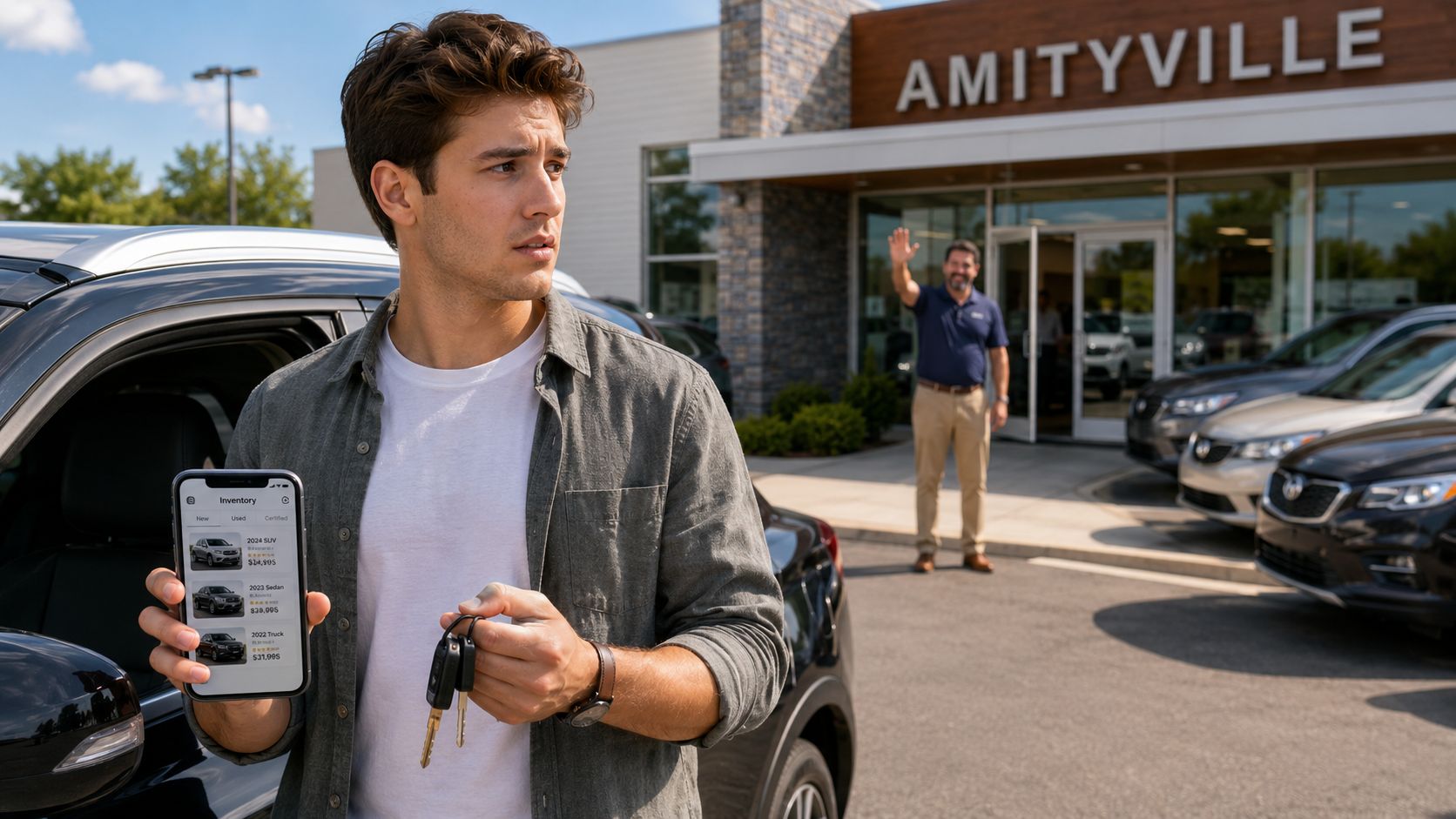
The first five minutes matter because they set the pace. If you walk in saying, “I just want to see what my payment would be,” the conversation can drift toward a monthly figure before anyone establishes the vehicle price, financing rate, term, trade value, or ownership costs. You need to arrive with a written ceiling and a short model list.
First-time buyers still represent a meaningful part of the market. In 2023, they accounted for 30% of new-car buyers, while the average new-car buyer age was about 53, according to the 2023 Car Buyer Journey Study summary from Cox Automotive. The practical point is simple. You’re not expected to know every dealership phrase, but you are responsible for knowing what you can afford.
The walk-up
Tell the salesperson exactly what you’re comparing. A useful opening sounds like this:
“I’m comparing a Grand Cherokee, Wrangler, RAM 1500, and Durango. I’ve set a total monthly ownership limit, and I want the out-the-door figures before we discuss payment.”
That sentence keeps the conversation anchored. It also tells the salesperson you’re serious without giving away your maximum budget.
The test drive
Don’t let a quick loop around the block decide a multi-year purchase. You need to drive the vehicle through a turn, over an uneven surface, and into a highway merge if possible. Long Island roads expose steering vibration, brake noise, harsh shifting, and cabin noise quickly.
The finance office and drive home
The finance office is where rate, term, protection products, and registration paperwork come together. Read every line before signing, and don’t accept an incomplete contract because you’re tired or because the showroom is closing.
The drive home is the final checkpoint. If the payment, insurance estimate, and vehicle fit still make sense after the excitement fades, you’ve made progress. If the deal only works because you ignored one of those items, stop.
Setting a Real Budget Before You Browse Inventory
A payment can fit your paycheck while the vehicle still strains your finances. Set the limit at your kitchen table before opening a Grand Cherokee, Wrangler, RAM 1500, or Durango listing. Near Amityville, the right choice depends on the full monthly cost, not the price displayed on the windshield.
Build the monthly ownership number
Start with take-home income, not gross pay. Subtract rent or mortgage, utilities, food, student loans, credit cards, childcare, subscriptions, and every other fixed obligation. The cash left afterward determines whether the vehicle works in your life.
Set 15% of take-home pay as a firm target for the car payment, then add the costs attached to ownership:
- Insurance: Ask your carrier for an estimate using the exact year, model, trim, and ZIP code. Premiums can differ between Amityville, Massapequa, Copiague, Farmingdale, and nearby towns.
- Fuel: Estimate your regular commute on the LIE, Southern State Parkway, local roads, and weekend trips. Budget for ordinary driving conditions, not an ideal fuel-economy result.
- Registration and parking: Include New York registration costs, workplace parking, apartment parking, and municipal permits.
- Maintenance reserve: Set aside roughly $50 per month as a planning reserve. Actual costs will vary by vehicle, mileage, and repairs.
- Financing: Base the calculation on the projected rate and term, not a payment shown before your credit is reviewed.
The vehicle class changes the monthly picture. A Wrangler or Grand Cherokee may carry different insurance and fuel costs than a smaller vehicle. A RAM 1500 adds truck-related fuel and usage considerations, while a Durango can make sense only if its added capacity justifies the ownership cost. Compare those expenses before deciding which model fits.
Cox Automotive’s buyer journey research reinforces the practical issue: buyers need to evaluate affordability before they reach the dealership. Limited savings leave less room for insurance, fuel, parking, and unexpected expenses, even when the initial payment looks manageable.
Turn the budget into a shopping band
Once you have the total monthly figure, set three limits:
- Purchase-price band: Choose the highest vehicle price that keeps the payment and ownership costs below your ceiling.
- Loan-term band: Select the shortest term that produces a manageable payment. A longer term can make an expensive trim look affordable while increasing the time you carry the balance.
- Down-payment target: Decide how much cash you can use without draining emergency savings.
Complete this worksheet before visiting a lot:
| Budget item | Your number |
|---|---|
| Monthly take-home income | $_____ |
| Fixed monthly obligations | $_____ |
| Maximum car payment | $_____ |
| Insurance estimate | $_____ |
| Fuel estimate | $_____ |
| Registration and parking | $_____ |
| Maintenance reserve | $_____ |
| Total monthly ownership limit | $_____ |
| Maximum out-the-door price | $_____ |
| Target down payment | $_____ |
| Acceptable loan term | _____ months |
Bring the completed sheet when you shop near Amityville. It keeps payment creep, unnecessary trim upgrades, and package additions from pushing the Grand Cherokee, Wrangler, RAM 1500, or Durango beyond what you can comfortably own. Insist on comparing out-the-door figures against your total monthly limit before choosing a vehicle.
Understanding Credit Scores and Auto Loan APR
A first-time buyer can choose the same Grand Cherokee as another customer and still pay far more each month. The difference is often the interest rate, not the vehicle. Experian’s 2026 auto-loan rate data by credit score lists average new-car APR at 4.55% for super-prime borrowers with scores of 781 or higher, compared with 16.01% for deep-subprime borrowers in the 300 to 500 range. For used vehicles, those same credit bands range from 6.30% to 21.77%.
These figures are market averages, not promises for your application. They show why comparing APR offers matters when you are measuring the Grand Cherokee, Wrangler, RAM 1500, or Durango by total monthly ownership cost.
See the spread before you sign
Run a loan calculator for a $30,000 loan over 60 months and compare the rates below. These payments and interest totals are illustrations, not lender offers.
| Credit tier | FICO range | Example APR | Monthly payment | Total interest paid |
|---|---|---|---|---|
| Super-prime | 781+ | 6% | $580 | About $4,800 |
| Prime | Not specified | 11% | $652 | About $9,100 |
| Deep subprime | 300 to 500 | 16% | $729 | About $13,700 |
A perfect score is not required to buy a vehicle. Rate preparation can protect your monthly ownership limit more effectively than arguing over a small accessory or trim difference.
Know what lenders review
The score in your banking app may differ from the score used for an auto loan. Lenders can review bureau information and auto-focused models, including FICO Auto Score 8. Ask every lender which bureau and scoring model it uses, then compare complete offers that show the APR, term, payment, and total finance cost.
Get pre-approved through a credit union or online lender before entering the finance office. Industry research shows that car shoppers commonly research vehicles through digital channels before visiting a dealership, according to the consumer car-shopping statistics compiled by Porch Group Media. Apply that same discipline to financing, especially before shopping near Amityville.
During the month before purchase:
- Pay down revolving balances: Lower reported card balances can strengthen your lending profile.
- Correct reporting errors: Pull your credit reports and dispute accounts, payments, or balances that do not belong to you.
- Avoid new credit lines: Skip store cards and unnecessary loans before applying for auto financing.
- Keep income records ready: Pay stubs and employment information can make approval cleaner.
Use the pre-approval as your rate benchmark. If a dealership offers different terms, compare the complete monthly cost, including insurance, fuel, parking, and maintenance, before you sign.
Comparing New, Used, and Certified Pre-Owned Options
The cheapest vehicle to buy isn’t automatically the cheapest vehicle to own. Compare depreciation, insurance, financing, warranty coverage, and maintenance risk together. That’s especially important for an SUV or truck, where a lower advertised price can come with an older warranty position or a less favorable loan rate.
| Cost factor | New | Used, 2 to 3 years old | Certified pre-owned |
|---|---|---|---|
| Depreciation | Highest early ownership loss | Some initial depreciation already absorbed | Lower than new, but depends on vehicle |
| Insurance | Often higher replacement value | May be lower, depending on model and coverage | Usually between new and regular used |
| Financing rate | May qualify for stronger programs | Can carry a higher APR | Often positioned between new and regular used |
| Warranty | Full new-vehicle coverage | Remaining factory coverage may be limited | Manufacturer inspection and limited warranty |
| Maintenance risk | Generally lowest at the start | Higher inspection burden | Lower risk than ordinary used, not risk-free |
New vehicles
New makes the most sense when you plan to keep the vehicle for years, want full factory warranty protection, and value current safety and technology. The trade-off is immediate depreciation. Industry data commonly places first-year value loss between 15% and 30%, with the sharpest decline soon after purchase, as explained in this vehicle depreciation guide from CarLife.
That loss can leave a buyer owing more than the vehicle’s market value when the down payment is small. Ask how long you expect to keep the vehicle before choosing a new Wrangler or RAM 1500 based only on the monthly figure.
Used vehicles
A clean two or three-year-old vehicle can offer a lower entry price and may have already absorbed part of its steepest depreciation. But inspect the history, tires, undercarriage, fluids, and remaining warranty carefully. A used vehicle may also fall outside the strongest new-vehicle finance programs.
Certified pre-owned
CPO is the middle path for buyers who want a lower price than new with more manufacturer-backed recourse than an ordinary used purchase. It still deserves an independent inspection and a close review of what the limited warranty covers.
Matching the Right Model to Your First Purchase
The four models on your list serve different lives. Don’t choose between the Grand Cherokee, Wrangler, RAM 1500, and Durango by comparing screens and wheel designs. Choose based on what you’ll do every week.
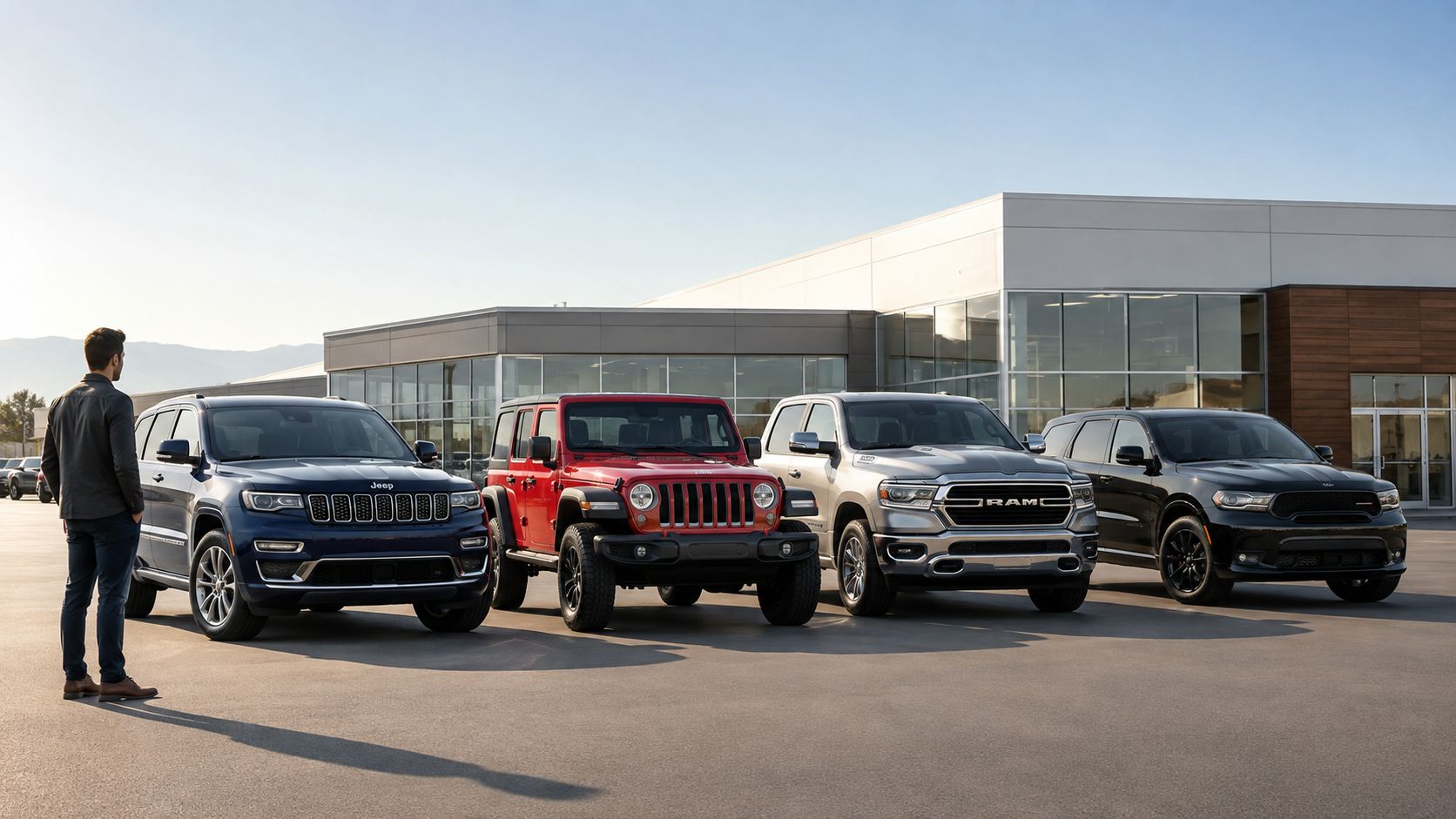
Grand Cherokee
The Grand Cherokee is the sensible all-around choice for a commuter who wants a comfortable cabin, family space, and weekend flexibility for trips toward the Hamptons. The available 4xe plug-in hybrid deserves a serious look if your charging routine supports it. For a new SUV comparison, the 2026 Grand Cherokee’s 2.0-liter turbocharged inline-4 produces 324 horsepower and 332 lb-ft of torque, paired with an eight-speed automatic transmission, according to Edmunds’ 2026 Grand Cherokee specifications.
It can tow up to 6,200 pounds, and Kelley Blue Book lists maximum cargo capacity at 70.8 cubic feet with a 6,050-pound GVWR, as shown in its 2026 Grand Cherokee specifications. For many first-time buyers, a mid-level trim with four-wheel drive and practical safety equipment is the value sweet spot. Avoid paying for appearance packages that don’t improve your daily use or resale appeal.
Wrangler
The Wrangler fits someone who wants trail capability, beach access near Jones Beach or Montauk, and open-air driving. It’s not the automatic recommendation for every Long Island commute. Ride quality, wind noise, entry height, and fuel economy are honest trade-offs, particularly if the vehicle spends most of its life on pavement.
Choose a practical trim with four-wheel drive and the equipment you’ll use. Hardtop, removable roof, and wheel packages can matter to resale, but don’t finance accessories because they look good on the lot.
RAM 1500
The RAM 1500 earns its place when your routine includes towing a boat, carrying project materials, or using the bed regularly. It also makes sense for a buyer who wants a notably quiet, comfortable truck cabin. The Big Horn and Lone Star trims are the sensible value targets. Compare bed length, cab configuration, four-wheel drive, and towing equipment before adding cosmetic packages.
A truck that never hauls anything still costs more to fuel, park, and insure than a smaller vehicle. Buy the RAM because your life needs a truck, not because a large vehicle makes the purchase feel more substantial.
Durango
The Durango is the family-hauling choice for buyers who need three-row flexibility and a more substantial road presence. It can be easier to justify than a truck when passengers and cargo matter more than an open bed. Choose the trim that supplies the seating, drivetrain, and safety equipment you need, then test the third row with the people who’ll use it.
For Long Island winters, evaluate four-wheel-drive availability and tire setup across every model. Your self-assessment is straightforward: do you need cargo comfort, open-air capability, truck utility, or three-row seating? Pick the model that answers that question without requiring an excuse.
The Test Drive and Inspection Checklist
A test drive should take about 30 minutes, not five. You’re not trying to become a mechanic in the parking lot. You’re checking whether the vehicle behaves properly, fits your body, handles your roads, and supports the phone and equipment you use every day.
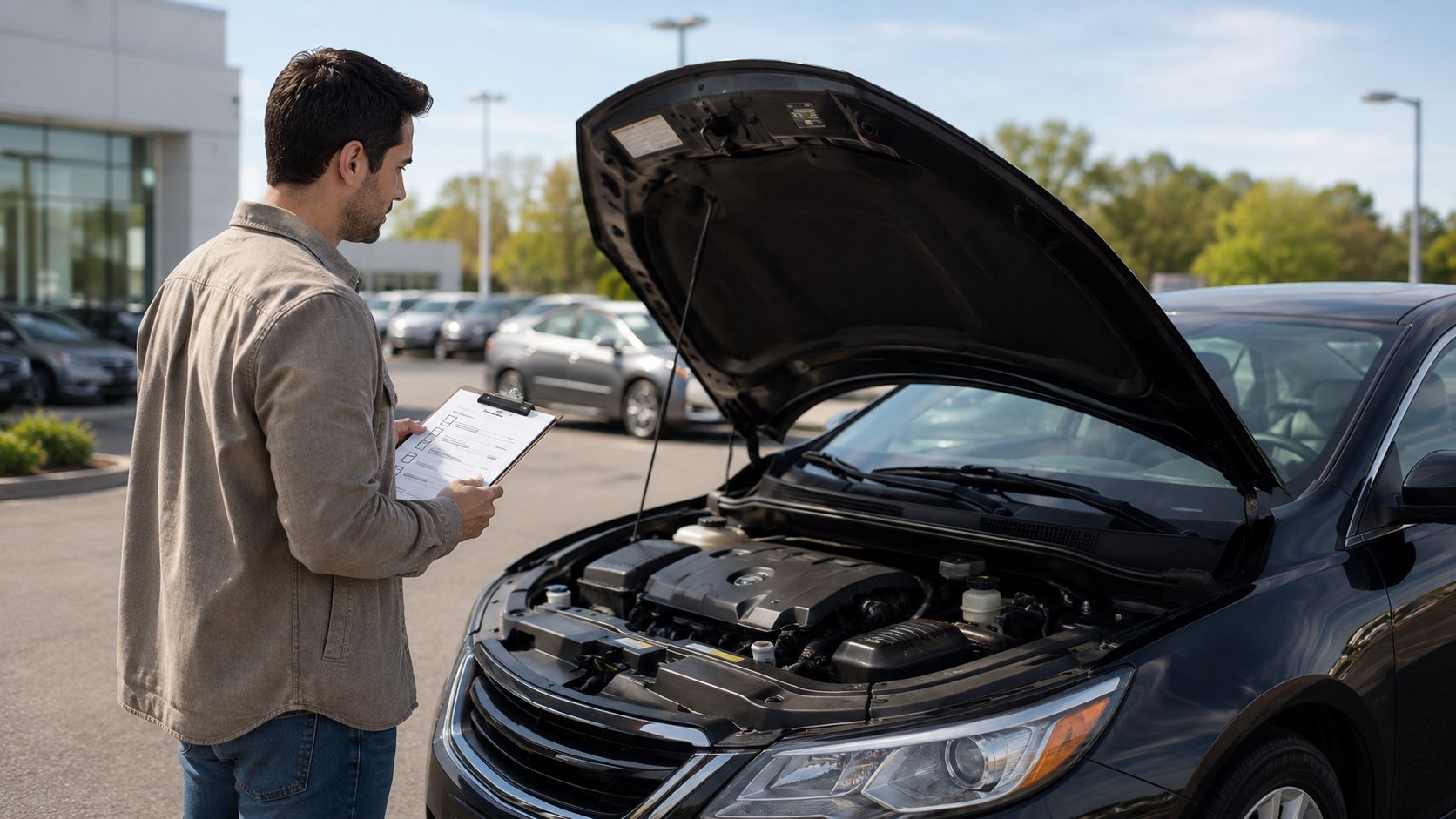
Before leaving the space
Ask whether you can start the vehicle cold. Listen for unusual noises, watch for warning lights, and let the engine settle into its normal idle. Check that the steering wheel sits straight and that the dashboard doesn’t display alerts that the salesperson can’t explain clearly.
Bring a flashlight, notepad, and your own phone charger. Connect your phone to the infotainment system, test the audio, and confirm that charging works where you expect it to.
Use a demanding route
Your route should include a bump, a turn, and a highway merge near the dealership. On the road, evaluate:
- Acceleration: Does it respond smoothly from a stop without hesitation?
- Braking: Does the pedal feel firm and predictable?
- Steering: Do you feel vibration through the wheel?
- Transmission: Are shifts smooth, especially in traffic and during acceleration?
- Cabin noise: Can you hold a normal conversation at highway speed?
- Visibility: Can you judge corners, lane position, and parking space limits comfortably?
Test every seat adjustment, climate control setting, window, mirror, and storage compartment. If you’re considering a Grand Cherokee or Durango for family use, put the people and child seats who matter into the vehicle before you decide.
If the vehicle is used or CPO
Inspect tire wear and fluid levels, look for inconsistent paint, and use a paint thickness gauge if you have one. Decode the VIN to verify the advertised trim and option packages. Ask for a vehicle history report and arrange an independent inspection before finalizing the purchase.
End by asking: “Can you show me the vehicle’s full out-the-door worksheet, the lender terms, and every optional product before I decide?” A clear answer tells you plenty about how the rest of the transaction will go.
Negotiation, Trade-In, and Paperwork Essentials
Negotiation, trade-in, and paperwork are one conversation with three separate outcomes. You want the correct vehicle price, a fair trade value, and a complete contract. Keep them separate long enough to verify each number.
Set the out-the-door price first
Ask for a written worksheet showing the selling price, taxes, DMV charges, registration, documentation charges, accessories, trade credit, down payment, APR, term, and total amount financed. New York-related charges can include DMV, registration, and tire and battery fees. Ask the dealer to identify each charge rather than accepting a vague “fees” line.
Then decline or evaluate add-ons individually. Extended warranties, GAP, paint protection, and prepaid maintenance may be useful in a specific situation, but they aren’t automatically good purchases. Ask what each product covers, what it costs, whether it can be canceled, and whether your lender requires it.
Practical rule: If an add-on appears only after you’ve agreed on the payment, pause the deal and price the vehicle again without it.
Keep the trade separate
Get the vehicle purchase figures before discussing the trade value. If you blend the two immediately, a higher trade allowance can hide a higher vehicle price or added products. Bring your payoff information, title details, keys, and maintenance records, then compare the appraisal with outside offers.
The trade doesn’t change what the vehicle costs. It changes how much cash or financing you need, so treat it as its own transaction.
Read the documents
Before signing, verify the odometer disclosure, bill of sale, title transfer information, lien payoff authorization, registration paperwork, APR, term, and amount financed. Ask how the dealer will handle registration processing for your Nassau or Suffolk address and when you’ll receive temporary and permanent documents.
For a used vehicle, request a clearly stated third-party inspection window before the deposit becomes nonrefundable. A deposit doesn’t replace an inspection. If the dealer won’t explain the cancellation, inspection, and refund terms in writing, don’t assume you’re protected.
Never take a vehicle home on incomplete or inaccurate paperwork. If the financing terms change later, the original excitement won’t make the new payment affordable.
Your Long Island Action Plan After Reading This
Start on Monday with a short list, not a showroom impulse. The buyer who arrives in Amityville with financing, model fit, and total ownership limits already organized has more control than the buyer who spends the afternoon chasing a payment.
Your week at a glance
Saturday: Pull your credit reports, check for errors, and write down your monthly take-home income and fixed obligations.
Sunday: Pre-qualify with two credit unions and one online lender. Compare APR, term, amount financed, required down payment, and any lender conditions. A lender’s pre-qualification isn’t a guarantee, so confirm what documents it needs for final approval.
Monday: Set your hard total-of-payments budget. Include the loan payment, insurance, fuel, parking, registration, and maintenance reserve. Then choose a short list of trims instead of browsing every vehicle in stock.
Before visiting: Call the Amityville-area store with the exact model and trim shortlist. Ask for availability, out-the-door pricing, current financing requirements, trade appraisal process, and inspection policy in writing.
Local conditions belong in the calculation. Your insurance ZIP rating can change the premium. A commute using the LIE and Southern State Parkway can make comfort, fuel use, and highway noise more important than a feature you’ll rarely touch. Salt exposure matters when you inspect pre-owned undercarriages, and the distance to a service bay matters when warranty work becomes necessary.
Keep these guardrails
- No payment-only discussion: Require the complete out-the-door worksheet.
- No rushed test drive: Drive the route and test the equipment you’ll use.
- No incomplete contract: Confirm APR, term, amount financed, products, and registration details before signing.
Email these questions before you arrive:
- Is the exact model and trim available?
- What is the complete out-the-door price?
- Which fees are included?
- What APR and terms can you offer after reviewing my pre-approval?
- What does the trade appraisal require?
- Can I arrange an independent inspection?
- Which warranty and protection products are optional?
- How will registration be handled for my Nassau or Suffolk address?
The goal isn’t the lowest sticker price. It’s the lowest three-year cost of ownership you can manage comfortably, delivered through a dealership relationship that still works when you need answers after the sale.
Security Dodge Chrysler Jeep RAM can help you compare new Grand Cherokee, Wrangler, RAM 1500, and Durango choices, review financing options, use a payment calculator, and request a vehicle through its locator tools. Bring your worksheet and lender terms, then visit Security Dodge Chrysler Jeep RAM in Amityville to review the numbers before you commit.
0 comment(s) so far on First Time Car Buyer Guide for 2026 Smart Shoppers