





How a Certified Pre Owned Dealership Works: RAM Buyer Guide
Does a certified inspection tell you whether a new RAM 1500 Big Horn costs less to own than a certified truck once you add fuel, interest, and the parts the warranty skips? Most shoppers stop at the badge. On Long Island, a RAM 1500, Jeep Wrangler, Grand Cherokee, or Dodge Durango choice is really three products: a new vehicle, a certified one, and a standard used one. The badge sits in the middle. It isn’t a full new-vehicle warranty, and it isn’t an as-is sale. Price the miles, the loan, and the exclusions before you treat certification as the safe default.
Table of Contents
- What a Certified Pre Owned Dealership Sells and Why It Matters
- New, Certified Pre Owned and Used Trucks Side by Side
- How Certification Works and What to Check Before Signing
- What CPO Warranties Cover and What They Leave Out
- RAM 1500 Trims Fuel Economy and Ownership Cost
- Financing and the Total Cost Before You Sign
- Compare New Models at Security Dodge Chrysler Jeep RAM
What a Certified Pre Owned Dealership Sells and Why It Matters
Say you live near Amityville and you want a RAM 1500 that still feels current. A certified pre owned dealership sells used vehicles that passed a manufacturer or dealer inspection, carry an extended warranty, and stay inside that program’s age and mileage caps. The truck or SUV sits between a new vehicle and a standard used one. It isn’t a new RAM or Jeep with a full factory warranty, and it isn’t an as-is sale.
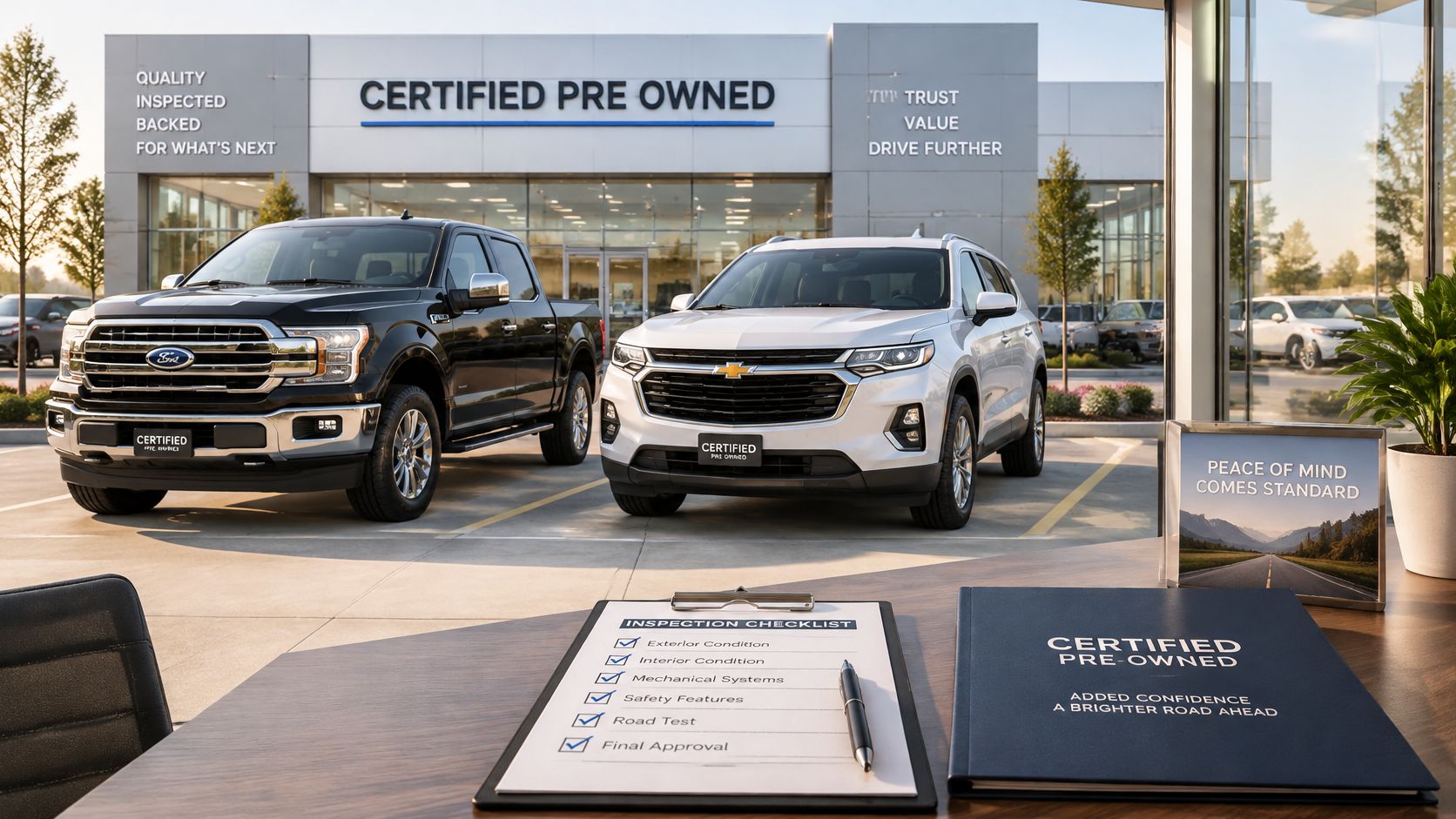
Certification lowers the chance of a costly surprise. It is a documented file of checks, not a promise that nothing will fail. The category is established, not a side lot. In 2023, approximately 2.64 million CPO vehicles were retailed nationwide, a 7% increase from 2022, and annual U.S. CPO sales over the decade ending in 2023 averaged about 2.62 million units, as Cox Automotive reported. That same reporting put 2023 volume above 2.6 million units, up 6.6% year over year, and later placed 2024 volume at about 2.5 million, down 3.6%, mainly because fewer young used vehicles qualified.
Jeep, RAM, and Dodge shoppers use this segment when they want a documented truck or SUV below new pricing. You benefit if you want warranty protection without new-vehicle pricing and you’ll still read the exclusions and the financed total.
What the file usually holds:
- Inspection sheet: The multi-point check the certifier signed.
- History report: Title, mileage, and prior events tied to the VIN.
- Warranty contract: Covered systems, term, and who pays parts and labor.
New, Certified Pre Owned and Used Trucks Side by Side
Pick the option that matches your budget and how much unknown history you can live with. A new truck costs the most and loses the most value in its first years. A standard used truck costs the least and carries the widest range of unknown history. Certified pre owned sits between them, pairing a lower price with a documented inspection and extended coverage.
| Feature | New | Certified Pre Owned | Standard Used |
|---|---|---|---|
| Typical age | Current model year | Usually under 6 years, set by the manufacturer | Any age |
| Warranty | Full new-vehicle factory warranty | Extended manufacturer coverage, often powertrain focused | Usually as-is or a short dealer warranty |
| Inspection | Factory pre-delivery inspection | Multi-point inspection with a history report | Whatever the seller chooses to show |
| Price level | Highest | Middle | Lowest |
| Depreciation exposure | Highest in the first years | Lower than new | Already absorbed, but repair risk is higher |
Think of a recertified rental car versus a private-sale car sold as is. Both have miles. Only one comes with a written inspection and a contract that names what breaks on the seller’s dime. A private sale can be a bargain, and it can also be a brake job, a title issue, and a dead battery in the same month.
A new RAM 1500, Jeep Wrangler, Jeep Grand Cherokee, or Dodge Durango is the direct alternative when you want current equipment and the full new-vehicle warranty instead of a shorter certified contract. Age and mileage caps differ by manufacturer, so confirm the program rules for that exact model year before you compare prices. A five-year-old truck that missed the mileage cap isn’t “almost certified.” It’s a standard used truck.
Practical rule: If you won’t read the exclusion list, you’re shopping a standard used vehicle with a nicer label.
How Certification Works and What to Check Before Signing
Certification is a sequence of records, not a badge on the windshield. The store builds the file first. You use that same file before you sign.

- Match the VIN on the title to the history report. Look for accidents, title brands, odometer problems, and how many owners are listed.
- Confirm there are no open safety recalls before delivery. A completed recall is a closed item. An open one is not.
- Run a multi-point inspection of brakes, tires, steering, suspension, battery, fluid leaks, and emissions equipment.
- Record diagnostic trouble codes and measured wear, including pad thickness and tire tread, not a pass or fail stamp alone.
- Repair the vehicle or reject it when the evidence conflicts. A clean history next to structural-repair signs, or mileage that doesn’t match the paperwork, is a stop.
- Approve certification only after the checklist, history report, repair orders, and warranty sit in one vehicle file.
- Hand over a Buyers Guide that matches any warranty you negotiated, naming covered systems, duration, and the dealer share of parts and labor.
History finds title and odometer risks an inspection can’t see. Inspection finds current faults a database may miss. A truck can look sharp and still hide a branded title. It can have a clean title and still have a leaking shock.
What you check on the vehicle
Read the inspection results before the test drive, not after you’ve fallen for the truck. Drive at highway speed and under hard braking. On Jeep and RAM models, engage 4WD or 4×4 and listen for a clunk the salesperson talks over. Ask for a third-party mechanic when the dealer allows it. Consumer Reports reports that CPO vehicles had about 14% fewer problems and 12% higher satisfaction than non-CPO used vehicles, and that coverage still differs by manufacturer and component. Certification also doesn’t necessarily disclose minor accidents or cosmetic repairs.
What you check on the paperwork
Keep the exclusion list, the diagnostic-fee rule, and the rule for repairs away from the selling dealer. Get an out-the-door price with every fee named. Optional add-ons can come off before you sign. Compare at least three trucks, and make one of them a new trim, so the certified price has a real benchmark.
Powertrain coverage may skip seals, electronics, glass, wear items, and problems that show up after you buy.
What CPO Warranties Cover and What They Leave Out
A certified warranty is a contract, not a general assurance that the truck is “covered.” Under the Federal Trade Commission Used Car Rule guide, every used vehicle offered for sale must display a Buyers Guide stating whether it is sold as-is, with implied warranties only, or with an express warranty. That disclosure must identify the covered systems, the warranty duration, and the dealer’s share of parts and labor costs. The final guide delivered at sale has to match any warranty change you negotiated.
A vehicle can pass a mechanical inspection and still have thin contractual protection. The warranty document matters as much as the inspection report. Keep the checklist, history report, repair orders, certification approval, and final warranty as one file you can pull up later.
| Component | Usually Covered | Usually Excluded |
|---|---|---|
| Engine internals | Yes, within the warranty term | Damage from neglected maintenance |
| Transmission and drive axles | Yes, within the warranty term | Clutch wear on manual units |
| Electrical modules and infotainment | Often covered for a set term | Aftermarket add-ons and some modules |
| Seals and gaskets | Often limited or left out | Leaks from normal age |
| Brakes, tires, wipers and filters | No | Wear items |
| Glass and cosmetic damage | No | Paint, dents and trim |
| Diagnostic fees | Only if the contract says the dealer pays | Buyer pays when no covered fault is found |
| Towing and rental | Included only if the contract lists roadside help | Left off unless you buy a roadside plan |
The signed warranty governs each row. A powertrain plan that pays for internal engine parts can still bill you for a seal, a sensor, or the hour a tech spent looking and found nothing warrantable. Commercial use and out-of-area repairs are common cutoffs, so read those lines if you tow for work or you split time off Long Island.
Ask these questions before you sign, and write the answers on the contract, not on a sticky note.
- Diagnosis: Who pays if the shop finds no covered defect?
- Where: Can an independent shop do the repair, or only the selling dealer?
- Transfer: Does the warranty follow the truck to a second owner?
- After the term: What do you pay the day coverage expires, and is there a deductible on each visit?
RAM 1500 Trims Fuel Economy and Ownership Cost
Two RAM 1500s with the same badge can carry very different fuel bills, and the gap is set by cab, drivetrain, engine, and bed before a trim name even enters the picture. For 2026, the entry Tradesman 4×2 Quad Cab with a 6-foot-4-inch bed carries an MSRP of $44,820, an EPA rating of 20 mpg city, 25 mpg highway, and 22 mpg combined, and an estimated range of 520 city miles or 650 highway miles, per Car and Driver. That single configuration is the measuring stick for everything above it in the lineup. Cab, drivetrain, bed length, destination, taxes, and dealer options all move the figure on the window label.
How the engines change the fuel bill
MotorTrend puts the 2026 RAM 1500 lineup at approximately $44,820 to $91,595 before fees and options. The entry-level V6 is estimated at 19 to 20 mpg city and 24 to 26 mpg highway. Hurricane SO trucks sit at about 17 to 18 mpg city and 24 to 25 mpg highway. High-output Hurricane models drop to about 14 to 15 mpg city and 16 to 21 mpg highway. The pattern works like a ladder: each step up in output costs a step down in city mileage, while highway numbers hold steadier.
| Configuration | Price Reference | Fuel Economy (City / Highway / Combined) | Affordability Note |
|---|---|---|---|
| Tradesman 4×2 Quad Cab, 6 ft 4 in bed | $44,820 MSRP | 20 / 25 / 22 mpg | Entry baseline, about 520 city or 650 highway miles |
| Entry V6 trims | From $44,820 within the lineup span | 19 to 20 / 24 to 26 / up to 21 mpg | Most efficient engine group |
| Hurricane SO trims | Above the Tradesman, inside the $44,820 to $91,595 span | 17 to 18 / 24 to 25 / inside the 15 to 21 mpg combined range | Middle efficiency |
| High-output Hurricane trims | Toward the $91,595 top of the lineup | 14 to 15 / 16 to 21 / about 15 mpg | Lowest efficiency, performance focus |
| Full lineup | $44,820 to $91,595 before fees | 15 to 21 mpg combined | Five-year cost about $72,832 to over $113,000 |
Five-year cost, not the sticker
Kelley Blue Book lists combined fuel economy from 15 mpg to 21 mpg, with 21 mpg combined on several lower-output configurations and 15 mpg combined on performance-oriented versions. The same listing puts five-year ownership, including fuel, insurance, and depreciation, from about $72,832 to more than $113,000. That spread shows the trim comparison, because two trucks that look close on the lot can land tens of thousands of dollars apart across five years.
Read the table as a comparison tool rather than a catalog. A certified pre owned truck changes only the first number in the deal, the purchase price, while fuel and five-year ownership move with the trim and engine rather than the certification badge. Popular mid trims such as Big Horn and Lone Star are the ones many buyers cross-shop, and for those the window label beats any lineup average once the buyer fixes 4×2 or 4×4, the bed, and the engine. A truck that costs more on the sticker can still come out ahead on the five-year span if it lands on the efficient side of the table.
Financing and the Total Cost Before You Sign
The sticker is the cover. The deal is the amount financed, the interest, the add-ons, and any repair deductible. A lower monthly payment can hide a longer term and more total interest. Compare APR and term, not the payment alone. A 72-month note can look kinder than a 48-month note and still cost thousands more in interest on the same truck.
Separate mandatory charges from optional products before you initial anything.
- Mandatory: Taxes, registration, and documentation fees.
- Optional: A service contract, gap coverage, and paint protection. You can decline these.
- Trade equity: Negative equity from a trade rolls into the loan and raises the amount financed.
Dealertrack shopper research found that 29% of shoppers struggle to understand the actual cost or benefit of finance-and-insurance products, while nearly 75% report higher satisfaction when purchase details are communicated transparently. A separate 2025 franchise-dealer satisfaction study in that same research named finance-and-insurance selection, affordability, final deal terms, trade-in offers, and financing completion as major friction points.
A certified truck can be more reliable and still cost more if the premium, the term, or optional products outweigh the repair bills you expected to avoid. Set the five-year fuel, insurance, and depreciation span for that exact RAM trim next to total interest at the quoted rate. Get a pre-approval from an outside lender and set it beside the store’s loan options. Terms change with your credit, down payment, and term, so a neighbor’s payment isn’t your payment.
Ask for total interest in dollars on that VIN, at that APR, for that term, before you talk monthly payment.
Compare New Models at Security Dodge Chrysler Jeep RAM
Start on the new lot when the comparison is close. A new RAM 1500 gives you the full new-vehicle warranty and a window-sticker fuel rating, while a certified truck can still leave coverage gaps you have to price. At Security Dodge Chrysler Jeep RAM of Amityville, run the Tradesman baseline against Big Horn and Lone Star, then set the winner beside a Jeep Wrangler, Jeep Grand Cherokee, and Dodge Durango.
The 2026 Wrangler starts at $36,035 and is listed at up to 20 mpg city and 23 mpg highway. For the Grand Cherokee, a specification on Jeep’s fuel-efficiency page lists a 2.0-liter turbo with 324 horsepower, 332 pound-feet of torque, 23 mpg combined, and a claimed 529-mile range; the model is listed with a starting MSRP of $35,000. For the Durango, compare each trim’s price and fuel economy on its window sticker before you set it against a certified alternative.
Buyers arrive from Amityville, Babylon, West Babylon, Copiague, Lindenhurst, Massapequa, and Wantagh with the same three decisions: what the warranty contract covers and leaves out, what the loan costs at the quoted APR and term, and which RAM 1500 trim has the lowest five-year cost for your miles.
Bring your annual miles, target APR, and exclusion questions, then ask for answers in writing. If a new Tradesman, Big Horn, or Lone Star beats the certified option on fuel, coverage gaps, and total interest, choose the new truck. Compare those trucks and SUVs at Security Dodge Chrysler Jeep RAM.
0 comment(s) so far on How a Certified Pre Owned Dealership Works: RAM Buyer Guide