





Jeep Wrangler Trim Levels Compared for 2026
For 2026, Jeep Wrangler trim levels run Sport, Sport S, Willys, Sahara, Rubicon, Rubicon X, and Moab 392, and the lineup starts at $36,035. The four-door Moab 392 starts at $69,995 with 470 horsepower from a 6.4-liter V8.
That spread is the whole buying problem in one lineup. A new Wrangler is not a single SUV with stickers on the fender. Each trim is a factory path aimed at a job, from open-air commuting to technical rock crawling. The smarter new purchase is often the lower trim suited to the hardest job you do often, not the highest badge on the lot.
If you’re shopping new on Long Island, the same budget conversation usually includes a Ram 1500, a Grand Cherokee, or a Durango. Those models don’t share the Wrangler’s removable doors, and they don’t share one fuel number either. Match the Wrangler to the job first, then set its running cost next to the truck or the family SUV you’re also considering.
Table of Contents
- 2026 Jeep Wrangler Trim Levels at a Glance
- What Separates Wrangler Trims by Job
- Sport Sport S and Willys for Daily Driving
- Sahara Rubicon and Moab Hardware
- Engines, Weight and Running Cost
- Which Trim Fits Each Kind of Driving
- Ram 1500 Trims with Published Starting Prices
- Ram 1500, Grand Cherokee and Durango Fuel Economy
- Shop a New Wrangler or Ram 1500 Near Amityville
2026 Jeep Wrangler Trim Levels at a Glance
Jeep’s 2026 Wrangler page lists the lineup starting MSRP at $36,035. Cars.com’s 2026 Wrangler trim listing lists the four-door Moab 392 at a $69,995 starting MSRP with 470 horsepower from a 6.4-liter V8. Between those two published anchors sit Sport S, Willys, Sahara, Rubicon, and Rubicon X. Most of those trims don’t have a separate published starting MSRP in the same public listings, so the window sticker is the price that matters.
Sort any new Wrangler with three rules before you fall in love with a color.
Body style. Sport, Sport S, Willys, Rubicon, and Rubicon X are built as two-door and four-door models. Sahara and Moab 392 are four-door only. If you need a real back seat every weekday, the two-door is already off the list.
Intended job. The jobs split into daily comfort, moderate trails, and technical rock crawling. Sport and Sport S cover the core open-air 4×4. Willys is the moderate-trail step. Sahara is the family-comfort branch. Rubicon and Rubicon X are the technical-trail builds. Moab 392 is the V8 specialty.
Powertrain. Engines in the current lineup are a 2.0-liter turbo, a 3.6-liter V6, or the 6.4-liter V8 on the 392. The badge doesn’t tell you which one is on the truck in front of you.
2026 Jeep Wrangler trim levels
| Trim | Body | Main job | Signature equipment | Starting MSRP |
|---|---|---|---|---|
| Sport | 2-door and 4-door | Core open-air 4×4 | Removable doors, fold-down windshield, skid plates, tow hooks | Lineup from $36,035 |
| Sport S | 2-door and 4-door | Daily comfort on Sport hardware | Convenience and appearance equipment over Sport | No separate published start |
| Willys | 2-door and 4-door | Moderate trail value | Trail-focused equipment between Sport and Rubicon | No separate published start |
| Sahara | 4-door only | Family comfort and highway manners | Refinement and four-door cargo practicality | No separate published start |
| Rubicon | 2-door and 4-door | Technical trails | Rock-Trac 4:1 low range, locking axles, disconnecting stabilizer bar | No separate published start |
| Rubicon X | 2-door and 4-door | Higher-content trail build | Rubicon hardware with added trail equipment | No separate published start |
| Moab 392 | 4-door only | V8 specialty performance | 6.4-liter V8, 470 horsepower | $69,995 |
What actually changes the vehicle
Door count, axle ratio, tire size, and engine change towing and fuel use more than the badge. Two Sport models can feel like different vehicles once one has the turbo, a shorter axle ratio, and a larger tire. A Rubicon with highway tires and an automatic won’t crawl the same way as a manual Rubicon with the short axle gears.
Practical rule: Shortlist two trims from this table, one you’d happily drive on Tuesday and one that covers your hardest weekend. Confirm that pair against the driving-job table later, not against a feature ladder that assumes higher is always better.
Bring both names to the store. A new order can be built around door count and engine once those two names are fixed.
What Separates Wrangler Trims by Job
Wrangler trims are factory equipment choices, not just different badges. The history of the Jeep Wrangler starts with the YJ in 1986, replacing the CJ, followed by the TJ in 1997 and the JK in 2007. Early trim names such as Base, Laredo, Islander, Sport, Sahara, Renegade, and Rio Grande already served different tastes, from basic four-wheel drive to distinctive appearance packages.
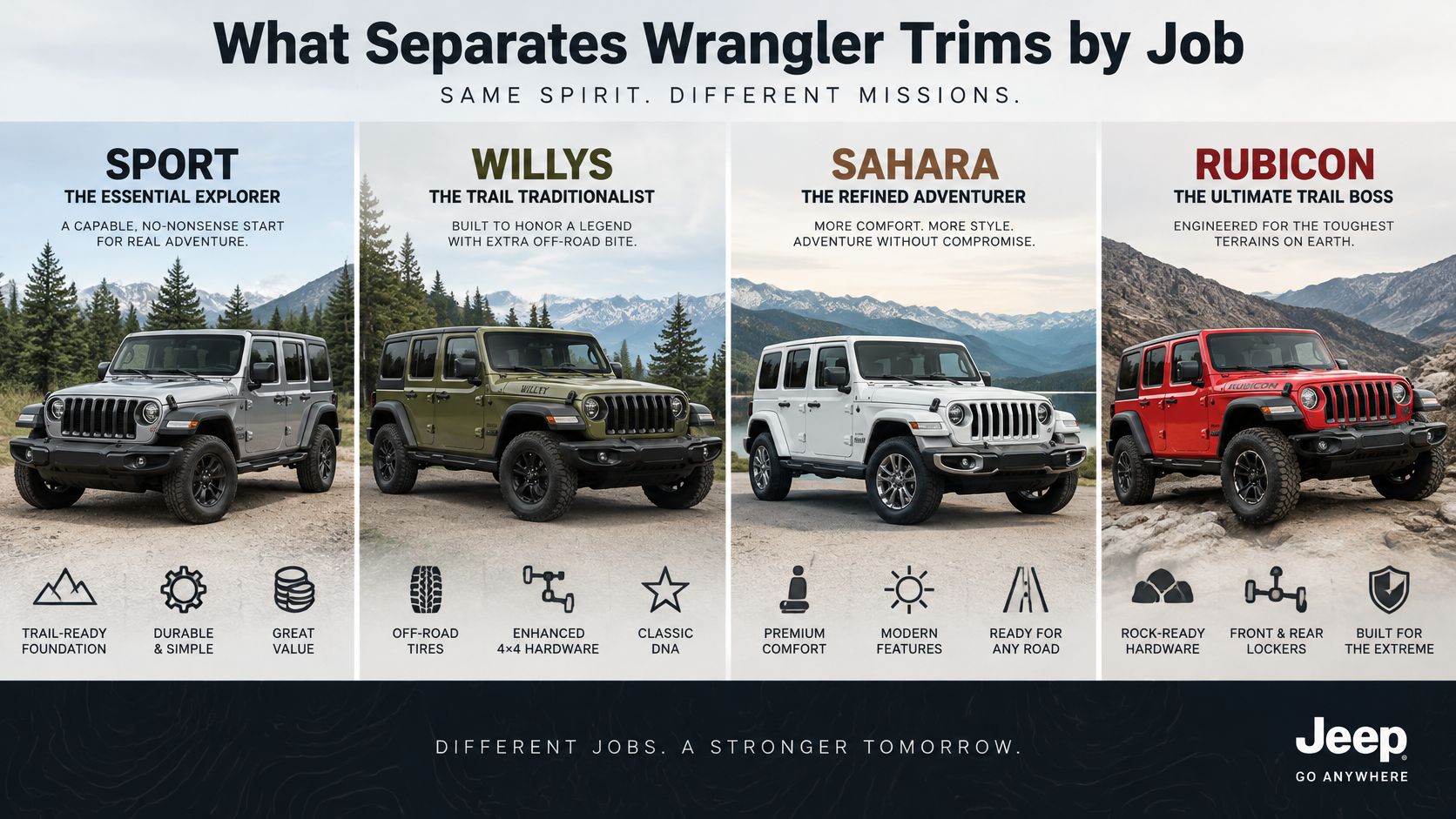
Today’s trim choices still reflect different jobs. Sport models prioritize core Wrangler capability, Sahara emphasizes comfort and appearance, and Rubicon adds trail-focused hardware. Specialty versions serve buyers seeking a more specific combination. The right choice depends on how you will use the vehicle: doors-off drives and mild trails call for different equipment than technical rock crawling. A higher trim is not automatically a better fit; it is better only when its added hardware or comfort suits your driving.
Sport Sport S and Willys for Daily Driving
Sport, Sport S, and Willys are the value band of a new Wrangler. You get the open-air body and four-wheel drive without paying for rock-crawling axles you may never use. Edmunds’s look at 2018 Wrangler trims is still the clearest published picture of that split. That year the two-door range was Sport, Sport S, and Rubicon, and the four-door range added Sahara. Sport’s foundational hardware included 17-inch steel wheels, skid plates, tow hooks, removable doors, and a fold-down windshield.
Sport is the core configuration
Sport is the core new Wrangler, in two-door or four-door form. You get the parts that make it a Wrangler on day one: doors that come off, a windshield that folds, underbody skid plates, and tow hooks. It is the right new purchase when the goal is the lowest-cost open-air 4×4 and the trails stay mild.
Say you live in a smaller place and rarely carry rear passengers. A two-door Sport is the light, simple choice. You drive it to work with the top on, take the doors off on a warm Saturday, and you don’t pay for convenience electronics or locker hardware. The compromise is comfort and rear-seat space, not four-wheel drive.
Sport S is the commuter step
Sport S keeps that same capability idea and adds convenience and appearance equipment. Power features and driver aids matter more here than trail-only parts. If your week is mostly pavement, Sport S is usually the better commuter than a bare Sport, and a better value than a Rubicon you bought for the name.
Picture a four-door commute across southern Long Island, with a beach afternoon or a snow morning a few times a season. A four-door Sport S gives you rear seats and the open-air body without a crawl-ratio transfer case. You still confirm the engine, transmission, axle ratio, and tire package on that exact window sticker. Those four lines change fuel use and how the vehicle feels at 65 mph.
Willys is the moderate-trail step
Willys sits between Sport S and Rubicon. It has more trail character than a commuter Sport S, and it stops short of the full locking-axle and extra-low crawl commitment. Aggressive tires help on fire roads and mild ruts. A 100:1 crawl ratio would sit unused on that kind of driving, so you shouldn’t pay for it.
A Willys owner who spends Sundays on sandy two-tracks and graded fire roads is using the trim for the job it was built to do. Lockers and an extra-low transfer case are for ledges, not for a washboard road.
All three of these trims still need the sticker read line by line. Engine, transmission, axle ratio, and tire package are not implied by the name Sport or Willys. Comfort-focused families should look at Sahara next. If your weekends are rock ledges, skip ahead to Rubicon.
Sahara Rubicon and Moab Hardware
Sahara and the Rubicon family solve different problems. Mixing them up is how people overpay.
Sahara is four-door only. It is the comfort and practicality Wrangler: rear-seat room, cargo space, and a more refined setup for families who still want removable doors and a fold-down windshield. It is not the technical trail benchmark. Highway miles, school runs, and a grocery load fit this trim. Repeated rock ledges do not.
What Rubicon hardware changes on the trail
Rubicon is the benchmark. Jeep’s Wrangler capability page specifies the Rock-Trac 4×4 system with a 4:1 low-range ratio, and an available 100:1 crawl ratio when that system is paired with the manual transmission and optional 4.88:1 axle gearing. The same trim includes Dana 44 axles, front and rear locking differentials, an electronically disconnecting front stabilizer bar, aggressive off-road tires, and rock rails.
Each part answers a specific trail problem.
Low range and short gears multiply torque at walking speed so you can creep a ledge instead of spinning.
Locking differentials keep a wheel that still has grip turning when the opposite wheel is in the air.
The disconnecting front stabilizer bar lets the axle articulate so a tire can drop into a hole instead of lifting the body.
Rock rails take the hit that would otherwise reach the rocker panels.
Four-door Rubicon models are rated for up to 5,000 pounds of towing. A trailer buyer has to verify that number on the exact build, because door count and axle equipment are part of the rating, not a bonus that every Wrangler shares.
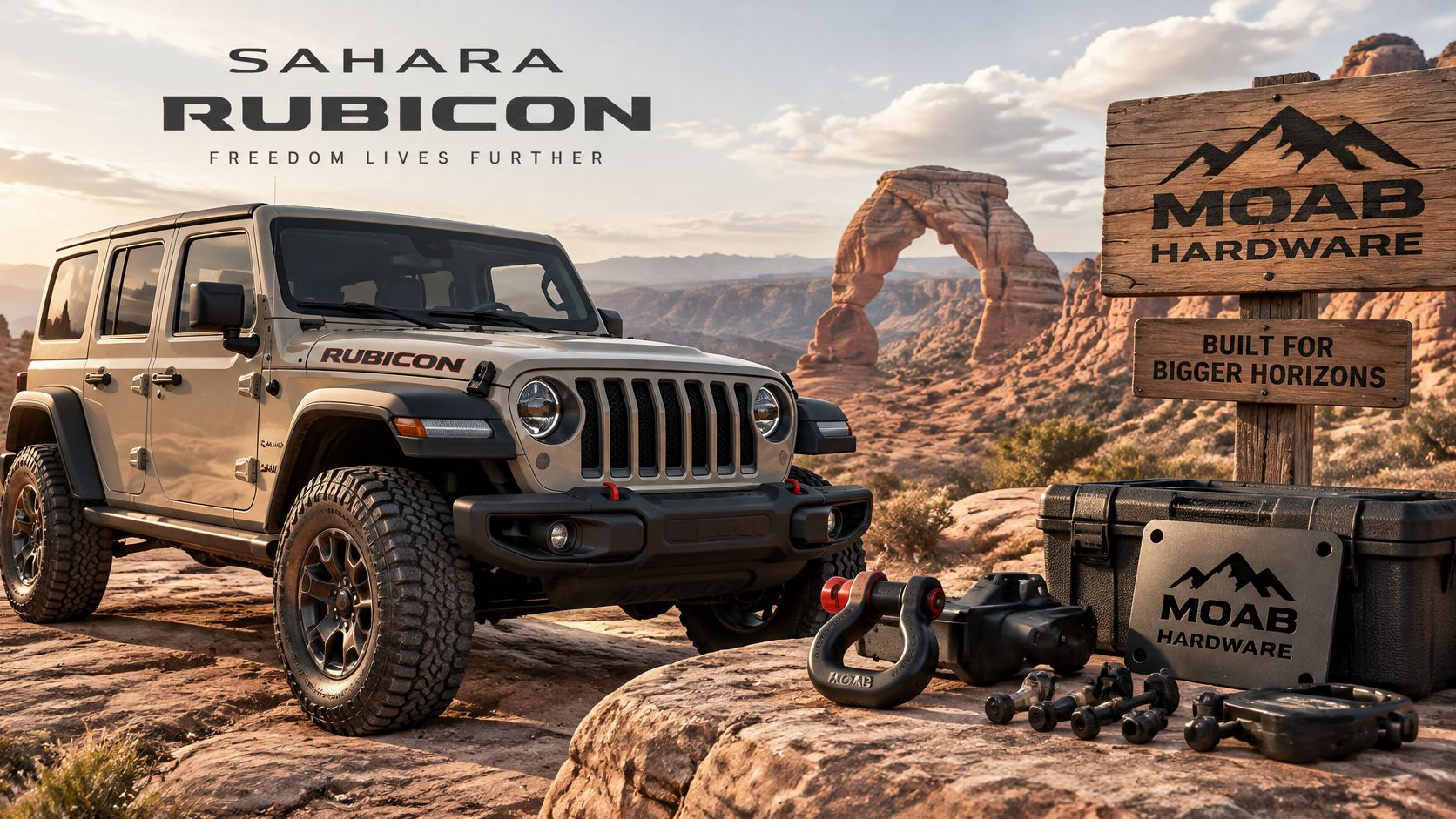
Rubicon X is the higher-content trail version of that same hardware, in two-door or four-door form. You pay for more trail equipment and a more finished cabin on top of the lockers and low range. Buy it when you will use the hardware and you also want the extra content every day. Don’t buy it as a styling upgrade for a paved commute.
Moab 392 is the four-door V8 specialty model. It is a different kind of top trim: power and presence, not a second copy of the family Sahara. If the appeal is the 6.4-liter engine rather than rear-seat refinement, this is the one to price. If the appeal is a quieter highway ride for kids in the back, stay with Sahara.
Who should stop, and who should pay
A parent doing highway miles and school runs should stop at Sahara. The four-door body already solves the people-and-cargo problem, and rock rails won’t make Monday morning better.
A driver who repeatedly faces rock ledges, deep ruts, or steep loose climbs should pay for Rubicon or Rubicon X. Those are the surfaces where a locker and a disconnecting bar change whether you move forward.
Available 35-inch tires add approach angle on the trail builds, and they also add tire cost, road noise, weight, and fuel use. That trade is worth it when rocks are the point. It is a poor trade when the vehicle lives on the Southern State.
If you commute and you don’t need lockers, go back to Willys or Sport S. Paved-road drivers can skip specialized axle and suspension equipment they will rarely use.
Engines, Weight and Running Cost
The engine choice changes the Wrangler’s feel more than its trim badge does. Jeep’s Wrangler FAQ lists three powertrains: the 2.0-liter turbocharged four-cylinder with 270 horsepower and 295 pound-feet of torque, the 3.6-liter Pentastar V6 with 285 horsepower and 260 pound-feet, and the 6.4-liter HEMI V8 in the Rubicon 392 with 470 horsepower and 470 pound-feet.
Which engine fits the way you drive
The turbo delivers its peak torque earlier, which can suit stop-and-go traffic and slow climbs. The V6 offers more peak horsepower and manual-transmission availability on several trims. The V8 is a specialty performance choice, so weigh its power against fuel costs before choosing it for daily commuting.
What the 2026 models weigh
Wrangler weight varies with body style, engine, tires, and equipment. Added weight also affects how much room remains for passengers, cargo, and trailer tongue weight under the vehicle’s ratings. Check the specific vehicle’s door label and towing information rather than assuming two Wranglers with the same trim name have identical limits.
A turbo or V6 is the more practical starting point for many daily drivers; the V8 suits buyers who specifically want its performance. Options can also raise the price beyond a trim’s starting figure, so compare the window sticker with the published starting prices for the lineup and Moab 392.
Six sticker lines that change the vehicle
- Door count. Compare the space you need for passengers and cargo with the vehicle’s weight and towing information.
- Engine. Turbo torque, V6 horsepower, and V8 output give the Wrangler different driving characters.
- Transmission. Manual availability on several V6 trims may appeal to drivers who want more control on a trail.
- Axle ratio. Gearing affects how the vehicle behaves while crawling and at highway speeds.
- Tire package. Larger, more aggressive tires can add trail capability along with road noise.
- Payload. The listed payload limits how much cargo and trailer tongue weight the vehicle can carry.
Compare these details on the window stickers before choosing between two Wranglers with the same trim name. The badge alone does not show every difference in gearing, tires, or capacity.
Which Trim Fits Each Kind of Driving
Rubicon is not automatically the best new Wrangler. FCA North America’s 2026 Wrangler announcement lists the lineup as Sport, Sport S, Willys, Sahara, Rubicon, Rubicon X, and Moab 392, with Sahara and Moab 392 limited to four-door models. The same specifications put an available 100:1 crawl ratio on the Rubicon with the manual and a 4.88:1 axle, and they note that 35-inch tires can raise the available approach angle to 47.4 degrees. Those features are worth real money on rocks. On a highway commute they add tire cost, noise, weight, and fuel use.
Factory capability is already in the order guide. Available 35-inch tires and the 2.0-liter turbo, 3.6-liter V6, and 6.4-liter V8 mean you don’t need an aftermarket build to get a serious new Wrangler. Modifying a lower trim to imitate a Rubicon usually costs more, and it can complicate warranty questions a stock truck never raises.
Minimum sensible Wrangler trim by driving job
| Driving job | Minimum sensible trim | Why not automatically go higher |
|---|---|---|
| Daily commuting | Sport S, or Sahara if four doors are required | Large tires and lockers add noise, weight, and fuel use |
| Beach driving | Willys or Sahara | Sand and cargo needs rarely require rock-crawling axles |
| Snow | Sport S or Willys | Four-wheel drive is already standard and lockers are optional |
| Towing | Four-door build with the printed tow rating | Ratings change with doors, axle, and equipment; Rubicon can reach 5,000 pounds |
| Trail exploration | Willys | Moderate ruts do not require the full Rubicon crawl setup |
| Technical rock crawling | Rubicon or Rubicon X | Needs low range, lockers, disconnecting bar, and available 47.4-degree approach |
Daily commuting points to Sport S, or to Sahara when you need four doors. Beach driving points to Willys when the sand is the main event, or Sahara when you also need cargo and rear seats. Snow points to Sport S or Willys because four-wheel drive is already part of the vehicle and lockers are optional on plowed roads. Towing points to a four-door whose printed rating you’ve read, not to a trim slogan. Moderate trail exploration points to Willys. Technical rock crawling is the job that requires Rubicon or Rubicon X.
Pick the lowest trim for the hardest job the vehicle will do often. Then confirm the engine and axle on that exact new vehicle. A Rubicon that sits in a garage all week is a more expensive way to commute.
Ram 1500 Trims with Published Starting Prices
A Ram 1500’s starting price depends on its cab, bed and drivetrain. MotorTrend’s 2026 Ram 1500 overview lists 11 trims, but starting prices are published there for only three. The figures below are for new trucks in the listed configurations.
2026 Ram 1500 trims with published starting prices
| Trim | Role | Starting price |
|---|---|---|
| Tradesman | Work-oriented entry trim | $44,820 (4×2 Quad Cab, 6-foot-4 bed) |
| Big Horn | Added equipment and styling above Tradesman | $50,075 (4×2 Quad Cab, 6-foot-4 bed) |
| Lone Star | Added equipment and styling above Tradesman | $50,075 (4×2 Quad Cab, 6-foot-4 bed) |
Big Horn and Lone Star share the same listed starting price and basic configuration. Their added equipment and styling make them alternatives to compare with the work-oriented Tradesman, especially if you want a more comfortable truck without moving to a luxury trim.
These figures are starting points, not like-for-like prices for every Ram 1500. A Crew Cab 4WD, a different engine or a different bed changes the configuration. Packages, destination charges, taxes and dealer-installed options also affect the final price. Compare the sticker, payload and tow rating for the exact truck you’re considering.
Ram 1500, Grand Cherokee and Durango Fuel Economy
Fuel economy follows the engine and the drivetrain, not the brand on the grille. A Wrangler’s available 2.0-liter turbo and 3.6-liter V6 are the regular-fuel engines in this comparison. The miles per gallon on any specific new Wrangler still come from that build’s door count, tires, and axle, so there is no single Wrangler mpg to memorize.
Car and Driver’s 2026 Grand Cherokee coverage is a useful contrast. Certain 2026 Grand Cherokee configurations are reported with EPA figures reaching 23 mpg city and 27 mpg highway. A V6 example is listed at 20 mpg city, 25 mpg highway, and 22 mpg combined. The same reporting puts the 2026 Durango in a wider, thirstier band, from 12 mpg city and 17 mpg highway to 18 mpg city and 25 mpg highway. KBB figures cited there reach up to 17 mpg combined with the standard V8 and as little as 13 mpg combined for the SRT Hellcat Jailbreak. That coverage also notes the Wrangler FAQ guidance that the turbo four and the Pentastar V6 are designed for regular unleaded gasoline rated at 87 octane, which keeps those two engines simpler to budget than a premium-fuel performance model.
Where the Ram 1500 lands
Edmunds’s 2026 Ram 1500 specs list a Big Horn Crew Cab 4WD with the 3.6-liter V6 mild-hybrid at 19 mpg city, 24 mpg highway, and 21 mpg combined. That 21 mpg combined rating is materially higher than the 15 mpg combined rating reported for the RHO, which uses the high-output Hurricane engine and requires premium gasoline. Other 2026 Ram 1500 configurations with the entry V6 can land around 19 to 20 mpg city and 24 to 26 mpg highway. High-output versions can fall to roughly 14 to 15 mpg city and 16 to 21 mpg highway.
2026 new-vehicle fuel economy lookup
| New model | Example configuration | Fuel figure |
|---|---|---|
| Jeep Wrangler | 2.0-liter turbo or 3.6-liter V6 | Designed for 87 octane; confirm mpg on the window sticker |
| Jeep Grand Cherokee | Selected 2026 configurations | Up to 23 city and 27 highway; V6 example 20 city, 25 highway, 22 combined |
| Dodge Durango | Standard V8 to SRT Hellcat Jailbreak | 12 to 18 city and 17 to 25 highway; 17 combined (standard V8) to 13 combined (SRT Hellcat Jailbreak) |
| Ram 1500 Big Horn | Crew Cab 4WD, 3.6-liter V6 mild hybrid | 19 city, 24 highway, 21 combined |
| Ram 1500 entry V6 | Base V6 configurations | About 19 to 20 city and 24 to 26 highway |
| Ram 1500 high-output | Hurricane engine, RHO | About 14 to 15 city and 16 to 21 highway; RHO about 15 combined on premium fuel |
Choose the Ram when bed size, payload, and that published fuel rating matter more than removable doors. Choose the Grand Cherokee when the higher highway figures and a closed cabin fit the week better than an open-air body. Choose the Durango when you need three-row space and you’ve already accepted a thirstier V8 or a performance model. Choose the Wrangler when the job is the open-air 4×4 and you’ve already picked the lowest trim that covers it.
Shop a New Wrangler or Ram 1500 Near Amityville
Security Dodge Chrysler Jeep RAM of Amityville is where we line up these new vehicles in one place. We’re a Jeep dealership serving Long Island, and the new inventory includes Chrysler, Dodge, Jeep, and Ram models. New vehicles on the lot include Chrysler Pacifica, Voyager, and Pacifica Plug-in Hybrid; Dodge Challenger, Charger, Durango, and Hornet; Jeep Cherokee, Wrangler, Wagoneer S, Grand Wagoneer, Grand Cherokee, Grand Cherokee L, Compass, and Gladiator; and Ram 1500, 2500, 3500, Chassis Cab, ProMaster, and ProMaster EV.
Shoppers often drive in from Copiague, Lindenhurst, Babylon, Massapequa, and Farmingdale. Those towns don’t have a separate inventory. The new Wranglers, Grand Cherokees, Durangos, and Ram 1500s are here in Amityville.
Bring a short list, not a wish for “the best trim.”
- Name two Wrangler trims and the door count. Sport S and Willys, or Sahara and Rubicon, is enough. A third name usually means the job isn’t decided yet.
- Pick the engine before the accessories. The 2.0-liter turbo, the 3.6-liter V6, or the Rubicon 392 V8 sets fuel, response, and price more than a wheel package.
- Add the Ram trim if the truck is still in the running. Tradesman, Big Horn, or Lone Star for work and daily use. RHO only if you want the high-output Hurricane and premium fuel.
- Read the window sticker on that specific new vehicle. Axle, tire package, tow rating, and fuel figures have to match the job you wrote down. A different unit of the same trim can wear different equipment.
New-vehicle shopping is the point of the visit. Certified and pre-owned listings are a separate conversation. Owners also get No Charge Worry-Free Maintenance, vehicle protection, dedicated 24/7 owner support, and VIP access to Jeep brand events or Ram brand events, which matters once the new truck is in your driveway.
Security Dodge Chrysler Jeep RAM in Amityville stocks new Jeep Wrangler, Grand Cherokee, Dodge Durango, and Ram 1500 models so you can compare trim, engine, and fuel on the same visit. Bring the two Wrangler trims you shortlisted, plus a Ram 1500 trim if a bed is part of the plan, and we’ll walk the window stickers with you. Visit Security Dodge Chrysler Jeep RAM and set a time to see the new lineup.
0 comment(s) so far on Jeep Wrangler Trim Levels Compared for 2026