




Jeep Wrangler vs Jeep Grand Cherokee: Which Fits You?
The usual advice, buy a Wrangler for adventure and a Grand Cherokee for comfort, leaves out the question that matters most: what will you pay for the capability you use? A smaller Jeep isn’t automatically the more economical purchase, and a pickup shouldn’t be dismissed before you compare its exact configuration.
For Long Island drivers, the Jeep Wrangler vs Jeep Grand Cherokee decision also deserves a look at the RAM 1500 and Dodge Durango. Start with your commute, passengers, parking, and hauling needs. Then choose the vehicle that handles those jobs without making you pay for equipment you’ll rarely use.
Table of Contents
- Why Wrangler and Grand Cherokee Buyers Want Different Things
- Size and Design Priorities Side by Side
- Off-Road Geometry and Trail Capability Compared
- Towing and Cargo Capacity for Everyday Hauling
- Fuel Economy Across Wrangler and RAM 1500 Models
- RAM 1500 Pricing Across Tradesman, Lone Star, and Big Horn
- Matching Each Buyer Type to the Right Model
- Taking Your Next Step at Security Dodge Chrysler Jeep RAM
Why Wrangler and Grand Cherokee Buyers Want Different Things
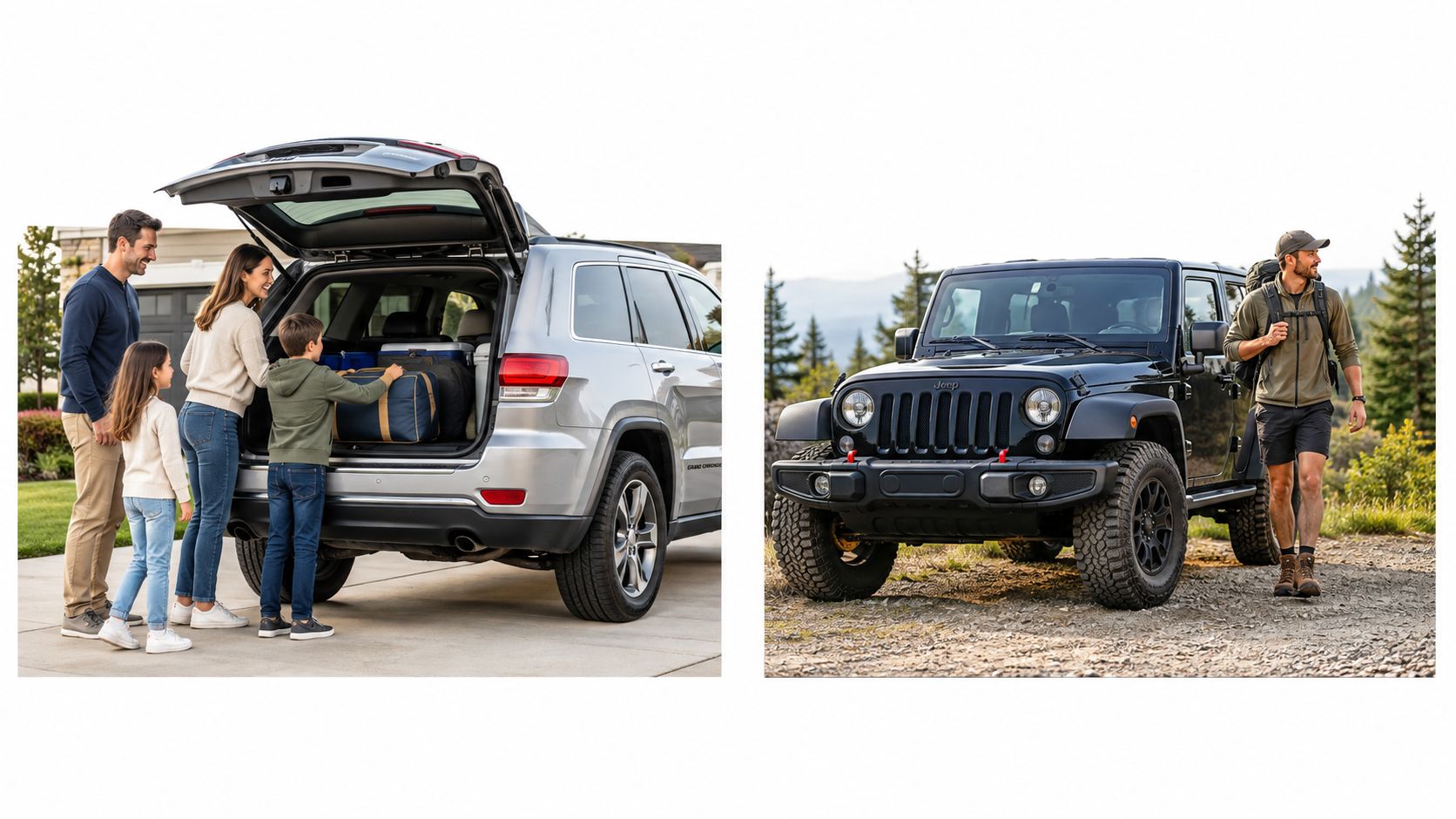
Choose the Grand Cherokee as your starting point for an everyday family SUV. Choose the Wrangler when its trail-focused design and open-air experience are reasons you want the vehicle. Those are different priorities, not different levels of Jeep ownership.
The Wrangler emphasizes maneuverability and removable body features. The Grand Cherokee puts more emphasis on enclosed passenger space, luggage capacity, and towing utility. Those design priorities are reflected in the Wrangler and Grand Cherokee specification comparison.
| Your main priority | Start your shopping with | Trade-off to examine |
|---|---|---|
| Open-air driving and technical trails | Jeep Wrangler | Everyday cabin and luggage needs |
| Family travel and enclosed cargo | Jeep Grand Cherokee | Exterior size and parking fit |
| A pickup bed for work or equipment | RAM 1500 | Cab, bed, drivetrain, and total price |
| A family SUV with an additional seating row | Dodge Durango | Seating arrangement and cargo access |
The Durango belongs on the shortlist if your passenger needs extend beyond the SUVs you’re initially considering. The RAM 1500 belongs there if a bed would solve a recurring problem, not just an occasional inconvenience. Don’t buy an SUV and repeatedly work around the absence of a truck bed if hauling is part of your routine.
Compare the vehicle, not just the badge
The new-vehicle figures discussed here concern 2026 specifications, with configuration-dependent ratings. Trim, engine, body style, and drivetrain can change the result, so the actual window sticker and applicable capacity documentation are the final checks.
Judge your shortlist against size, trail capability, towing, cargo, fuel consumption, purchase price, and configuration. Whether you’re a family buyer, trail driver, or commuter, that approach gives you a more useful answer than choosing by reputation.
Size and Design Priorities Side by Side
Parking convenience and passenger space pull buyers in different directions. A vehicle that’s easier to position in a crowded downtown space may demand more compromise when everyone brings luggage.
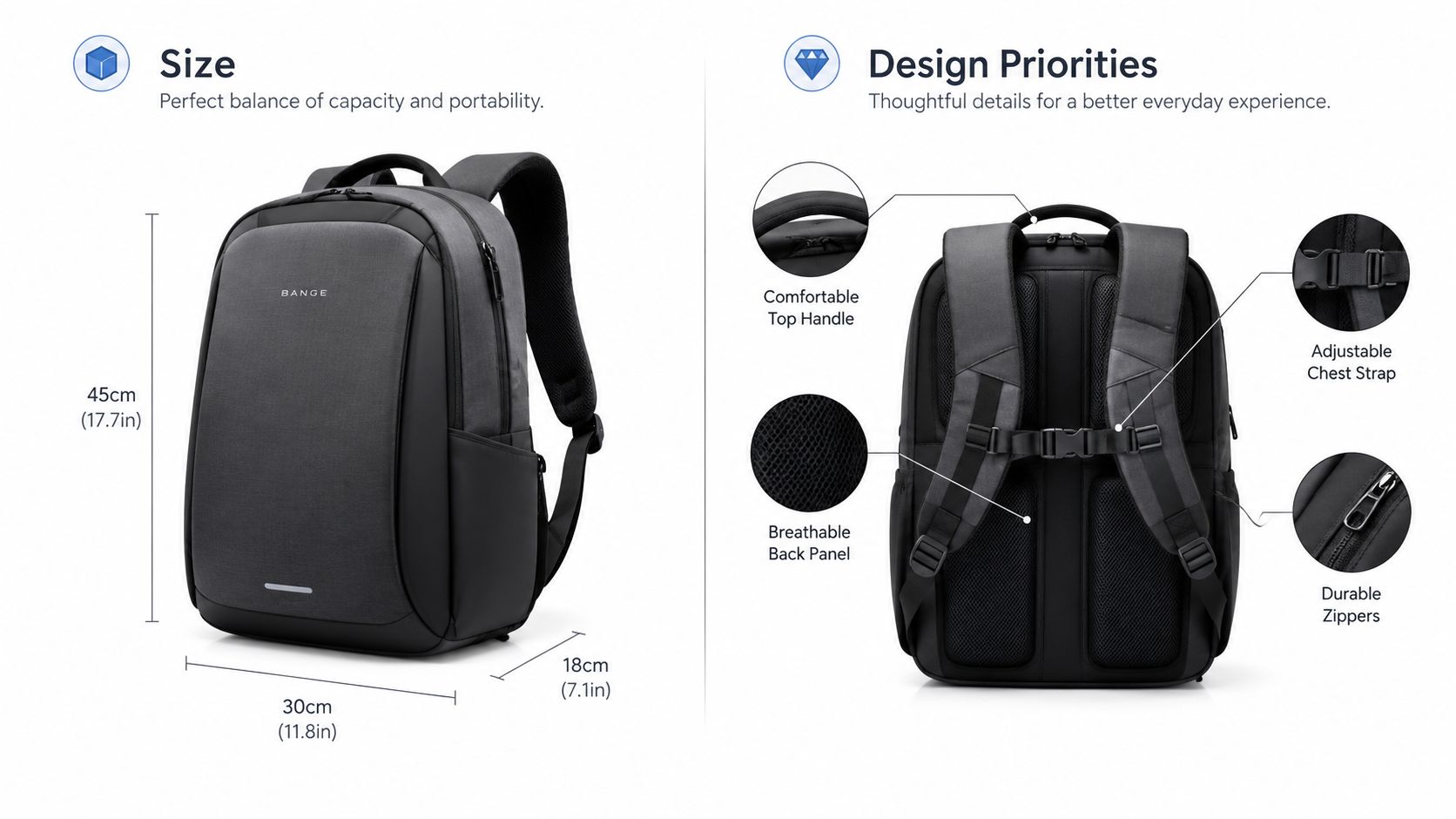
The listed dimensional comparison puts the four-door Wrangler at approximately 166.8 inches long with a 96.8-inch wheelbase, against approximately 193.5 inches and a 116.7-inch wheelbase for the two-row Grand Cherokee. That represents roughly 26.7 inches more overall length and 19.9 inches more wheelbase for the Grand Cherokee, using the comparison specifications noted earlier. Confirm the Wrangler body style carefully before applying those dimensions to a particular vehicle, because body-style identification is critical to an accurate comparison.
What you’ll notice around Long Island
My recommendation is to assess exterior fit before getting attached to a trim. If your normal routine includes parallel parking in Amityville or squeezing into a crowded shopping area in Massapequa, test the vehicle in a space that resembles what you use.
For driving along Sunrise Highway or the Southern State corridor, place more weight on how settled the vehicle feels and whether passengers have enough room. The Grand Cherokee’s longer proportions favor that type of use, while the Wrangler’s compact, trail-oriented layout serves a different purpose.
Practical rule: Don’t accept a daily space compromise just because you like a vehicle’s appearance. Bring the people and belongings that normally travel with you.
Check entry and loading in person
Ground clearance and overall vehicle height aren’t interchangeable measurements. Clearance describes space beneath the vehicle, not the exact height of its seat or cargo opening.
Get into the front and rear seats, then lift a typical bag into the cargo area. Pay attention to the step up, door opening, sill, and reach to the seat. For a buyer making repeated school, shopping, or work stops, those movements deserve as much attention as the exterior dimensions.
Off-Road Geometry and Trail Capability Compared
Buy the Wrangler for obstacles, not just for bad weather. Technical terrain creates demands that a snowy residential street doesn’t, and the Wrangler’s geometry is a meaningful reason to choose it.
The published 2026 two-door Wrangler figures include approximately 9.7 inches of ground clearance, a 41.4-degree approach angle, a 35.9-degree departure angle, and a 32.7-foot turning circle. The corresponding Grand Cherokee comparison lists about 8.4 inches of clearance and a 38.0-foot turning diameter, according to the published off-road and dimensional comparison.
What the measurements actually do
Approach angle concerns the front of the vehicle as you climb toward an obstacle. If you’re approaching a rock ledge, it helps describe whether the front bodywork can clear before the tires begin climbing.
Departure angle concerns the rear as you drive off that obstacle. A shorter wheelbase also helps reduce the risk of contacting the underside when crossing a crest, while a tighter turning circle can make a narrow trail easier to negotiate.
- Rock ledges: Prioritize clearance and approach geometry rather than appearance packages.
- Uneven trail crests: Consider wheelbase and the risk of grounding the vehicle between its axles.
- Tight trail turns: Look at maneuverability, not just whether a model has four-wheel drive.
- Open-air outings: Decide whether removable body features are something you’ll actually use.
Match capability to your destination
A weekend built around technical upstate trails gives the Wrangler a clear purpose. For serious trail use, put the Rubicon configuration on your comparison list and examine its exact equipment rather than assuming every Wrangler is equivalent.
For gravel access roads, moderate trails, and winter commuting, evaluate a suitably equipped Grand Cherokee against the actual conditions you expect. Don’t treat rock-crawling geometry as a substitute for checking tires, drivetrain operation, and your own comfort behind the wheel.
My verdict: choose the Wrangler when challenging trails are part of the plan. If your concern is getting through ordinary seasonal conditions while maintaining a practical daily vehicle, start with the Grand Cherokee and verify its configuration.
Towing and Cargo Capacity for Everyday Hauling
A trailer or a full load of family equipment can settle this comparison quickly. The Grand Cherokee is the stronger starting point when enclosed cargo and towing are regular requirements, while Wrangler buyers need to pay particular attention to body style and configuration.
Towing and Cargo Ratings at a Glance
The following towing and cargo comparison specifications are configuration-dependent maximums, not interchangeable ratings for every vehicle bearing the same model name.
| Measure | Jeep Wrangler | Jeep Grand Cherokee |
|---|---|---|
| Maximum towing by configuration | Two-door, 2,000 pounds; standard four-door, generally 3,500 pounds; Rubicon 392, 5,000 pounds | Up to 6,200 pounds |
| Cargo with rear seats folded | About 31.7 cubic feet in the two-door | Up to 70.8 cubic feet |
| Cargo behind the rear seats | Approximately 13 cubic feet in the listed Wrangler comparison | Approximately 38 cubic feet behind the second row |
Those cargo measurements describe different seating arrangements. Don’t compare a folded-seat maximum with another vehicle’s seats-up capacity and assume both can carry the same passengers at the same time.
For a Long Island landscaping project, begin with the loaded weight of the utility trailer, not its empty weight. For a family trip, start with the passengers who need seats and the equipment that must remain inside. A larger maximum cargo number is irrelevant if reaching it means folding seats your family needs.
The useful towing rating is the one your exact vehicle can support with your passengers, cargo, and trailer attached.
Confirm the whole towing setup
Payload matters because passengers, luggage, accessories, and trailer tongue weight all affect the load the vehicle carries. You can reach a vehicle’s carrying limit before reaching its advertised maximum trailer weight.
Before committing, ask for a configuration-specific review:
- Engine and axle ratio: Confirm which towing rating applies to the vehicle being quoted.
- Tow equipment: Verify the required package and installed hardware.
- Payload allowance: Review the actual vehicle’s load information, not a model-wide maximum.
- Tongue-weight limits: Check compatibility with the trailer you intend to pull.
- Seating and luggage: Keep your normal passenger load in the calculation.
Review the window sticker alongside the capacity labels and applicable towing documentation. No single headline figure replaces those checks.
Fuel Economy Across Wrangler and RAM 1500 Models
Smaller doesn’t automatically mean less fuel. Compare the engine, transmission, body style, and drivetrain you’ll buy, not the most favorable rating attached to the model name.
The turbocharged four-cylinder two-door Wrangler is listed at 20 mpg city, 23 mpg highway, and 21 mpg combined. V6 versions are approximately 19 or 20 mpg combined, depending on transmission, while the Wrangler 392 is listed at 13 mpg city and 16 mpg highway in the 2026 Wrangler fuel-economy comparison.
A truck deserves an actual comparison
The RAM 1500 Tradesman 4×2 Quad Cab with a 6-foot-4-inch bed provides a useful configuration-specific benchmark: 20 mpg city, 25 mpg highway, and 22 mpg combined, according to the listed Tradesman efficiency specifications. That doesn’t make every RAM equally economical, but it does undermine the assumption that choosing the smaller SUV always saves fuel.
The listed Lone Star configuration returns 19 mpg city, 24 mpg highway, and 21 mpg combined, with an estimated fuel cost of $239 per month in the RAM 1500 specification listing. Treat that monthly figure as an estimate for the cited specification, not a promise about your driving bill.
Selecting four-wheel drive can change both purchase price and fuel consumption. If you don’t need it for your work or driving conditions, compare the rear-wheel-drive truck before paying for additional capability.
Treat a plug-in hybrid as a separate decision
Wrangler 4xe and Grand Cherokee 4xe ownership requires a charging plan, not just enthusiasm about electrification. Ask where you’ll charge, whether your daily routes suit electric operation, and what warranty coverage applies.
A NHTSA safety recall notice covers certain 2023–2025 Grand Cherokee 4xe and 2024–2025 Wrangler 4xe vehicles, describing potential engine failure, loss of propulsion, or fire. Those listed years don’t establish the status of a new vehicle outside that population. Verify the exact VIN and current recall status before deciding, rather than assuming either universal risk or universal clearance.
RAM 1500 Pricing Across Tradesman, Lone Star, and Big Horn
The RAM 1500 should be judged as a lineup, not a single price point. A work-focused truck and a luxury configuration may share a model name while making very different demands on your budget.
The listed 2026 Tradesman 4×2 starts at $44,820, the Lone Star at $50,680, and the Tungsten at $88,800, a $43,980 spread between the cited Tradesman and Tungsten configurations. Their respective combined fuel-economy figures are 22, 21, and 17 mpg, and the Tungsten specification requires premium fuel, according to the listed RAM trim pricing and efficiency comparison.
Where Big Horn and Lone Star fit
Compare Big Horn and Lone Star by equipment, not by assumptions about their names. Big Horn is the mid-range choice to examine alongside Lone Star, but don’t assign it a fixed price without identifying the truck’s engine, drivetrain, cab, bed, and options.
Start with Tradesman if the truck’s job matters more than additional amenities. Move toward Big Horn or Lone Star when their specific equipment improves how you’ll use the vehicle. Consider other RAM 1500 trims only after identifying what you need beyond those configurations.
A premium interior can be worth paying for if you spend substantial time in the truck. It isn’t automatically good value if purchasing it forces you to compromise on the bed, cab, or hauling configuration you need.
Build an honest affordability comparison
For shoppers in Babylon, Lindenhurst, Massapequa, and Farmingdale, compare written quotes on equivalent configurations. A lower advertised figure isn’t a useful advantage if the other truck includes equipment you would otherwise have to add.
- Acquisition cost: Compare vehicle price, destination charges, taxes, and applicable incentives.
- Fuel needs: Check both the consumption rating and required fuel grade.
- Equipment value: Identify which options solve a recurring need and which are preferences.
- Financing terms: Review the down payment, term, and total amount financed alongside the monthly payment.
Budget test: If an option doesn’t improve a job you regularly ask the truck to do, make it justify its place in the purchase.
Don’t claim a complete ownership-cost winner from sticker price alone. Get insurance quotes and review financing terms before deciding what comfortably fits your household budget.
Matching Each Buyer Type to the Right Model
The right recommendation starts with the job the vehicle must do most often. Don’t let a memorable test-drive moment outweigh the routine you’ll repeat throughout ownership.
Families should begin with Grand Cherokee
My recommendation for a household replacing its main family vehicle is Grand Cherokee first. Use its enclosed-space and hauling advantages as the baseline, then determine whether its actual seating layout suits your family.
Bring the child seats, stroller, sports bags, or other items you regularly carry. Have the usual rear-seat passengers get in, and check whether loading luggage requires rearranging belongings every time.
If you need an additional seating row, compare the Dodge Durango and verify the seating configuration on the exact vehicle. Don’t choose it solely because it appears larger; test access to the seats you intend to use and inspect the remaining luggage area.
Question to answer first: Who rides with you daily, and what must fit without folding their seats?
Trail drivers should choose Wrangler deliberately
For buyers who plan technical off-road outings and value open-air driving, Wrangler is the direct recommendation. Compare the Rubicon configuration when serious trail use is part of the intended job.
The important budget distinction is between equipment you need for planned terrain and equipment you like looking at. Be specific about where you’ll drive, then ask which factory configuration addresses those demands.
A Wrangler is a valid personal choice even when practicality isn’t the only priority. The mistake is pretending the compromises don’t exist, rather than deciding they’re worthwhile.
Question to answer first: What terrain will you really drive, and how often will you use the equipment you’re paying for?
Commuters should separate comfort from truck utility
For highway-oriented commuting without a recurring need for a bed, begin with Grand Cherokee. Judge the seat, driving position, and overall comfort on a route resembling your normal drive.
If you carry materials, dirty equipment, or bulky items regularly, compare a RAM 1500 Tradesman 4×2 before moving up the trim ladder. Big Horn and Lone Star deserve attention when their equipment addresses a real preference or requirement, not because a higher trim seems like the expected choice.
Question to answer first: How much of your week involves highway driving, and does a pickup bed solve a frequent enough problem to determine your purchase?
Taking Your Next Step at Security Dodge Chrysler Jeep RAM
Make your dealership visit a comparison exercise, not an open-ended search. Arrive with a short model shortlist, your routine passenger and hauling requirements, and a monthly budget that still leaves room for fuel and insurance.
Ask for a configuration-based discussion
The Amityville dealership offers new Jeep, Dodge, and RAM vehicles, along with auto loan options for a new purchase. Use the visit to compare available trims in person and request help reviewing the window stickers behind the prices, fuel ratings, and equipment you’re considering.
- Identify the vehicle: Ask which engine, drivetrain, body style, and package combination supports the quoted rating.
- Compare your finalists: Drive the shortlisted vehicles over similar roads and test their everyday usability.
- Check the truck specification: Determine whether Tradesman, Big Horn, or Lone Star provides the equipment you need without unnecessary additions.
- Review the purchase terms: Request an itemized quote and financing details before deciding on affordability.
Browse new inventory and model pages on the dealership’s website before visiting, then confirm availability of the configurations you want to compare. For shoppers coming from nearby Long Island towns, that preparation keeps the appointment focused.
Schedule a test drive at the Amityville location and check the differences that matter in person: maneuverability, passenger access, driving comfort, and the equipment you’ll use day to day.
Compare new Jeep, Dodge, and RAM vehicles and discuss auto loan options at Security Dodge Chrysler Jeep RAM. Bring your Wrangler, Grand Cherokee, RAM 1500, or Durango shortlist to the Amityville location and schedule a test drive of the configurations that fit your daily routine and budget.
0 comment(s) so far on Jeep Wrangler vs Jeep Grand Cherokee: Which Fits You?