





Lease a Jeep in 2026: Costs, Mileage and Steps
The average U.S. auto lease payment was $659 per month in 2025, according to Experian’s June 2025 lease-payment data. That’s a useful benchmark, but it doesn’t tell you whether a particular Jeep lease is affordable. Upfront cash, mileage charges and fuel can change the answer considerably.
If you want to lease a Jeep in 2026, judge the complete driving bill, not the advertised payment. For drivers around Amityville, that means comparing a new Grand Cherokee or Wrangler with alternatives such as a RAM 1500 or Dodge Durango, then matching the contract to your actual Long Island driving.
Table of Contents
- Leasing vs Buying a Jeep for Your Budget
- How to Work Out Your Jeep Lease Payment
- Pick the Right Mileage Allowance for Long Island Driving
- Fuel Economy and Affordability for Jeep and RAM Models
- Credit, Eligibility and Documents to Bring
- Negotiate the Lease and Protect Your Return
- Start Your Jeep Lease at Security Dodge Chrysler Jeep RAM
Leasing vs Buying a Jeep for Your Budget
Lease if you want a newer vehicle regularly and don’t intend to keep it long term. Buy if you keep vehicles for years, drive heavily or want ownership without return conditions. Leasing can make a new Jeep or RAM 1500 easier to fit into a monthly budget, but a smaller payment isn’t automatically a better financial decision.
A lease generally charges for the vehicle’s depreciation during your contract, plus a finance charge and applicable fees and taxes. A purchase loan finances the vehicle’s purchase balance instead, which is why financing the same vehicle usually produces a higher monthly payment.
Leasing vs buying a Jeep at a glance
| Factor | Leasing | Buying |
|---|---|---|
| Upfront cash | Due at signing, set by the lessor and often negotiable | Down payment, usually larger, plus taxes and fees |
| Monthly payment | Covers depreciation plus a finance charge, usually lower | Covers full loan repayment plus interest, usually higher |
| Mileage | Capped by the contract, extra miles billed at turn-in | No cap and no mileage penalty |
| End of term | Return the Jeep, buy it at the residual value, or walk away after settling obligations | You keep the Jeep and any equity it holds |
| Wear and damage | Charged against you at return if beyond normal wear | Repaired at your cost whenever needed |
Buying gives you an asset, although its market value can fall below your loan balance. Returning a leased vehicle leaves you without an ownership stake in that vehicle, and starting another lease means taking on another payment commitment.
Leasing also limits how freely you can use the vehicle. A Wrangler shopper who wants permanent modifications, frequent demanding trail use or an unpredictable travel schedule should weigh those plans against the return requirements.
Budget test: Choose the arrangement that fits how you’ll use the vehicle, not the arrangement that makes the most expensive trim appear affordable.
As a practical screening scenario, a driver covering about 12,000 miles annually, wanting a replacement every few years and having no ownership plans is a reasonable lease candidate. That isn’t an approval rule or a universal mileage recommendation. If your driving or ownership plans don’t fit that scenario, compare a purchase quote before committing.
How to Work Out Your Jeep Lease Payment
Ask for a complete worksheet before discussing whether the payment feels comfortable. Consumer Reports’ lease-negotiation guide explains that multiplying a 0.00166 money factor by 2,400 produces an approximate 3.98% APR. Converting that unfamiliar decimal makes the financing component easier to evaluate.
Use the worksheet to separate the vehicle price from the financing terms and upfront cash.
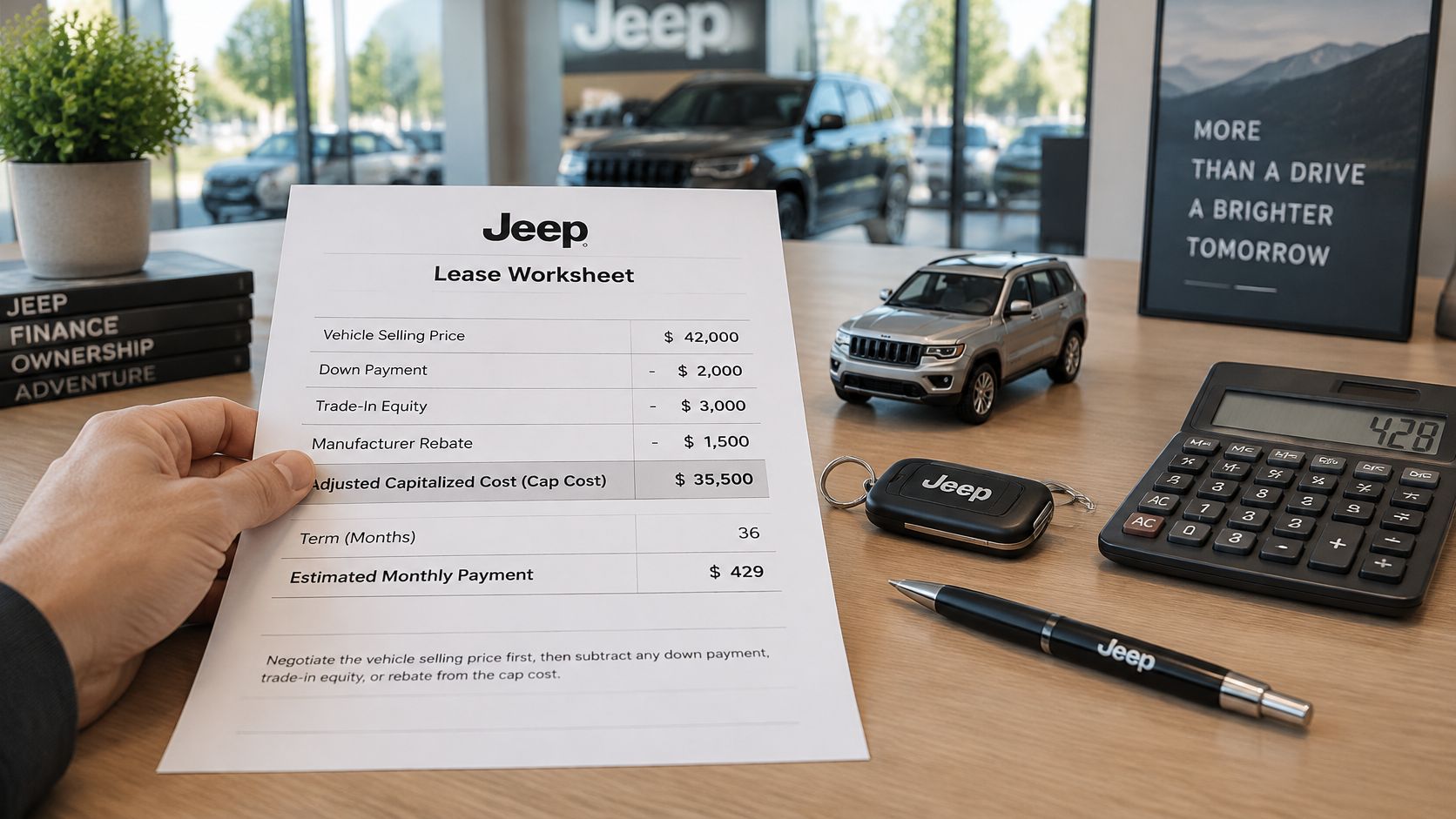
Build the payment from its components
- Negotiate the selling price first. This establishes the starting vehicle cost before financing, incentives and optional products complicate the discussion.
- Find the adjusted capitalized cost. Add any financed charges to the negotiated price, then subtract eligible rebates, cash reductions and trade-in equity applied to the lease.
- Confirm the residual value. This is the contract’s stated end-of-term vehicle value, not a figure you should estimate from an online resale listing.
- Calculate monthly depreciation. Subtract the residual from the adjusted capitalized cost, then divide the result by the contract’s number of months.
- Translate the money factor. Request the actual factor used in your quote and its approximate APR equivalent so you can assess the financing terms.
- Calculate the monthly finance charge. Add the adjusted capitalized cost and residual, then multiply that sum by the money factor.
- Add taxes and identify separate fees. Ask how applicable New York taxes are collected and whether any taxes or fees are financed rather than paid upfront.
Don’t assume the selling price and adjusted capitalized cost are identical. An acquisition charge rolled into the lease increases the financed amount, while a rebate applied as a capitalized-cost reduction lowers it.
A hypothetical payment calculation
Suppose the selling price and adjusted capitalized cost are both $40,000, the residual is $26,000, the term is 36 months, and the money factor is 0.00166. These are illustrative inputs, not an advertised offer.
| Component | Hypothetical calculation | Result |
|---|---|---|
| Monthly depreciation | ($40,000 − $26,000) ÷ 36 | $388.89 |
| Monthly finance charge | ($40,000 + $26,000) × 0.00166 | $109.56 |
| Base monthly payment | $388.89 + $109.56 | $498.45 before tax |
In that hypothetical example, scheduled base payments total $17,944.20. Add upfront amounts not already counted, applicable taxes and separate acquisition or disposition charges to establish the complete scheduled lease cost.
Avoid double-counting the first payment if it’s included in the amount due at signing. Equally, don’t ignore a large cash reduction because it makes the monthly figure look better. Require an itemized cash-flow total so competing quotes can be compared on equal terms.
Pick the Right Mileage Allowance for Long Island Driving
Excess mileage cost on a 36-month lease
The following scenario assumes you drive 15,000 miles annually and your contract charges $0.25 per excess mile. The Consumer Reports leasing comparison describes excess-mileage penalties of approximately $0.10 to $0.50 per mile and the same potential $3,750 exposure on a lower-mileage contract.
| Annual allowance | Excess miles at 15,000 a year | Charge at $0.25 per mile |
|---|---|---|
| 10,000 miles | 15,000 | $3,750 |
| 12,000 miles | 9,000 | $2,250 |
| 15,000 miles | 0 | $0, but the monthly payment is higher |
The Federal Trade Commission’s financing and leasing guide says standard leases commonly allow 15,000 miles per year or less, with higher allowances generally increasing the payment. That increase deserves a calculation, not an automatic rejection.
Compare the allowance upgrade with the projected bill
Using the hypothetical table, moving from the lowest allowance to the highest avoids $3,750 in projected overage. Across that illustrative 36-month term, the break-even increase is approximately $104.17 per month.
For the middle allowance, avoiding the hypothetical $2,250 charge is worth $62.50 per month over the same term. Compare the actual allowance upgrade with those avoided charges, including any tax difference, rather than treating the lower advertised payment as the winner.
Buy the mileage you expect to use. Don’t choose an allowance that requires you to change a commute you can’t realistically change.
Start with your prior 12 months of odometer records, then add expected changes. A different job, school drop-offs, family visits or weekend travel can make last year’s total too low.
Apply that method whether you live in Amityville, Copiague, Lindenhurst, Babylon, West Babylon, Farmingdale or Massapequa. A town name doesn’t establish your mileage needs. Your destinations, travel frequency and route do.
Count distance separately from traffic time
For trips along the Southern State Parkway or Long Island Expressway, record actual miles rather than guessing from time spent behind the wheel. Traffic can extend a journey without adding distance, while detours and extra stops can increase both.
Keep a commuting estimate and a separate allowance for personal travel. Ask for alternative mileage quotes before signing, because you shouldn’t assume the lessor will let you add miles later on favorable terms. Unused miles also generally don’t earn a credit, so excessive padding isn’t automatically good value.
Fuel Economy and Affordability for Jeep and RAM Models
2026 RAM 1500 fuel economy by engine and drivetrain
Combined figures come from Car Fact Sheet’s 2026 RAM specifications. Edmunds’ 2026 RAM 1500 overview puts V8 versions at approximately 18 mpg combined and some high-performance configurations near 15 mpg combined.
| Configuration | City mpg | Highway mpg | Combined mpg |
|---|---|---|---|
| 3.6L V6 eTorque mild hybrid, 4×4 | 20 | 25 | 22 |
| 3.0L Hurricane standard output, 4×4 | 17 | 24 | About 20 |
| 3.0L Hurricane high output, 4×4 | 15 | 21 | 17 |
The fleet guide ties the V6 estimate to four-wheel drive, so treat it as a single rating rather than a spread across drivetrains. Confirm the combined figure on the actual truck’s window sticker, and never derive an official combined rating by averaging city and highway numbers.
Engine selection sets your fuel cost before trim ever enters the picture.
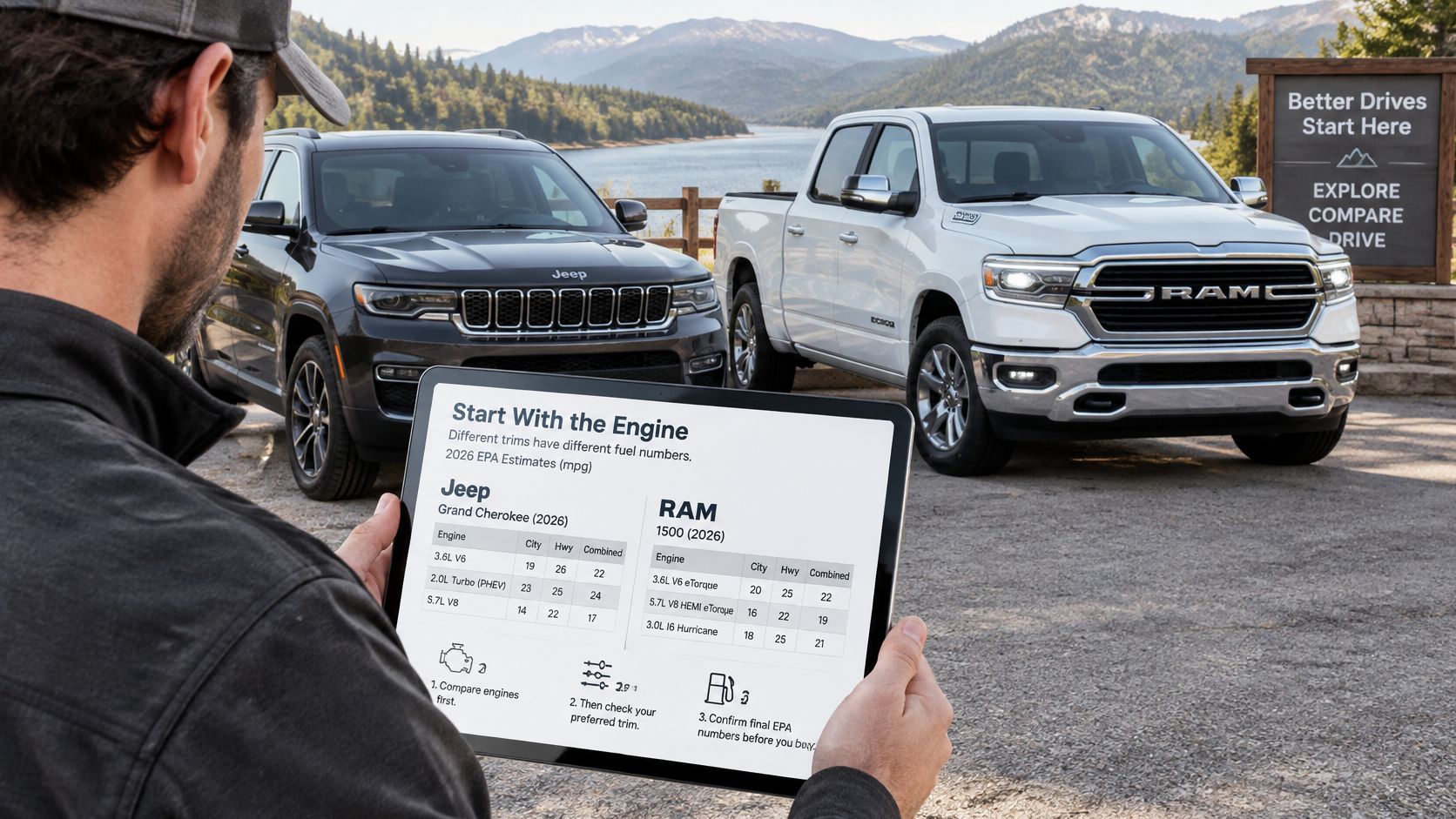
Shop RAM capability before appearance packages
Big Horn and Lone Star are trims, not fuel-economy specifications. Compare the engine, drivetrain, cab, bed and equipment on each actual truck. Apply that discipline across all RAM 1500 trims, not only the versions carrying the most attractive advertised payments.
Pick the capability you need, then find the least expensive configuration that delivers it. A high-output engine with a lease payment close to a milder truck’s still costs more every time you fill up, and that gap repeats for the entire term.
In a hypothetical 15,000-mile driving year, a truck rated at 22 mpg combined uses about 682 gallons, while one rated at 17 mpg combined uses about 882 gallons. That is roughly 200 additional gallons annually, calculated straight from the ratings in the table.
Multiply that gallon difference by the fuel price you pay. Then check whether the engine calls for a different fuel grade, because equal pump prices should never be assumed.
Compare the SUVs by their actual builds
Car and Driver’s 2026 Grand Cherokee overview lists up to 21 mpg city and 27 mpg highway for the 2.0-liter turbocharged 4×2, with configuration-dependent figures spanning approximately 19 to 23 city and 26 to 27 highway. Its comparison also places the 360-horsepower V8 Durango at 17 mpg combined.
For the Wrangler, pull the rating for the exact build on your shortlist rather than borrowing a figure from a different configuration. For the Durango, decide whether the performance gain justifies the fuel bill that follows it for the full lease term.
Run every candidate through the same formula: scheduled lease cost plus expected fuel expense, with insurance quoted separately. That math, not the advertised monthly payment, tells you which Jeep or RAM fits your budget.
Credit, Eligibility and Documents to Bring
Prepare your application before choosing a payment target. A lender evaluates credit history, income stability and existing debt, and the advertised terms may not match the approval your application receives.
There isn’t one universal credit-score cutoff for every lease program. Ask whether pre-approval is available, whether the process involves a credit inquiry and which terms remain subject to final lender review.
Bring a complete application file
- Identification: Bring a valid driver’s license with information that matches your application.
- Income evidence: Gather recent pay stubs, or tax returns and supporting income documents if you’re self-employed.
- Residence verification: Have current proof of your address available.
- Insurance information: Bring your current declaration page so coverage can be checked against the lessor’s requirements.
- Trade-in paperwork: Bring the title, registration and current payoff information when applicable.
- Application details: Have your employment, housing and other requested financial information ready.
- Signing funds: Confirm the accepted payment method for the final due-at-signing amount before your appointment.
Don’t assume an existing insurance policy automatically satisfies a lease. Confirm the required collision coverage, liability limits and permitted deductibles with the lessor and your insurer.
Separate approval from affordability
A lender’s approval tells you the application meets its underwriting requirements. It doesn’t tell you whether the lease leaves enough room for fuel, insurance, housing and other commitments.
Keep trade-in equity visible on the paperwork rather than treating it as free money. If a balance remains on your current vehicle, ask how that payoff affects the proposed transaction before discussing a replacement.
John Garcia is a Finance Manager at Security Dodge Chrysler Jeep RAM. Ask our finance team to confirm the exact document list for your application and explain any outstanding lender conditions before you commit.
Before signing: An application approval isn’t a substitute for a household budget that still works after insurance and fuel are included.
Resolve missing documents and coverage questions early. You’ll make a clearer decision when the appointment is about reviewing an understandable contract, not scrambling to complete a file.
Negotiate the Lease and Protect Your Return
A payment-first negotiation gives away too much information too early. If you name only a monthly ceiling, you can end up evaluating a deal with more upfront cash, less mileage or unwanted products rather than a better vehicle price.
Ask for a selling-price proposal before negotiating the financing details. Keep the vehicle configuration consistent while comparing offers, because a different engine or equipment package changes what you’re buying access to.
Challenge every unexplained line
Request the money factor and residual in writing. Ask whether the quoted factor includes any markup and whether you qualify for a different program.
Have the finance team identify optional products separately. Paint protection, coverage products and accessories shouldn’t disappear into the capitalized cost without a clear explanation of what they cost and whether you want them.
- Incentive eligibility: Confirm which manufacturer lease incentives apply to you and whether alternative cash rebates can be combined with that program.
- Acquisition charge: Establish whether it’s paid upfront or financed.
- Disposition charge: Identify the amount and any written waiver conditions.
- Early termination: Request the contract’s calculation method rather than assuming you can leave by paying a small cancellation fee.
- Purchase option: Confirm the contractual buyout amount and any separate purchase-option charge.
Don’t rely on a verbal assurance that an obligation will probably be waived. If it matters to your decision, get the applicable condition in writing.
A clean lease agreement is one you can explain without repeating the salesperson’s payment pitch.
Prepare the vehicle before the return appointment
A pre-return inspection gives you time to compare repair options rather than accepting an unexpected bill under time pressure. Ask when the lessor permits that inspection and arrange it before the final handoff.
Use a practical return checklist:
- Photograph condition: Take dated pictures of body panels, glass, wheels, tires and interior surfaces.
- Check equipment: Account for both keys and every accessory supplied with the vehicle.
- Gather records: Retain maintenance documentation and receipts for any completed repairs.
- Review wear standards: Compare tire condition and damage with the lessor’s written rules before authorizing work.
- Document the handoff: Keep the odometer disclosure, return receipt and any inspection paperwork.
Don’t assume returning the vehicle settles every obligation immediately. Review the final account statement and question charges that don’t match the contract or documented condition.
Start Your Jeep Lease at Security Dodge Chrysler Jeep RAM
Start with your mileage and fuel budget before choosing a configuration. Those figures determine whether a low payment stays affordable after driving costs, and they narrow the right vehicle faster than a reservation.
Once your requirements are clear, prepare your application documents and request a written quote. Security Dodge Chrysler Jeep RAM offers vehicle leasing, and its team of financial lease and loan experts helps create a package that fits within the customer’s budget. Treat that quote as a comparison tool, because the monthly payment is only one line in the total lease cost.
Request a quote you can evaluate
Ask the team for new-vehicle comparisons of a Jeep Grand Cherokee, Jeep Wrangler, Dodge Durango or RAM 1500 in configurations that match your needs. Keep the Dodge and RAM alternatives in the comparison if their capability fits your driving better.
Your written proposal should make these items easy to locate:
- Vehicle and price: Exact configuration, negotiated selling price and adjusted capitalized cost.
- Lease terms: Money factor, residual value and contract length.
- Cash requirements: Due at signing, monthly payment and itemized fees.
- Driving costs: Mileage allowance, excess-mileage rate and return conditions.
Put the window-sticker fuel estimate beside each proposal and weigh it against the mileage you expect to drive. Compare the amount due at signing, the payments over the full term, expected fuel spending and possible excess-mileage charges together. A truck that costs less to lease can still cost more to drive when you select an engine for performance you rarely use.
If your preferred vehicle is still being built, contact the dealership about reserving it. The team can discuss locking in pricing and eligible incentives. Confirm the applicable terms before making that commitment.
Sign only when the total cost, mileage allowance and return terms fit your plans. If one doesn’t fit, change the configuration, contract or buying method rather than stretching your budget to preserve an attractive monthly number.
Security Dodge Chrysler Jeep RAM offers new-vehicle leasing and finance guidance for drivers comparing Jeep, Chrysler, Dodge and RAM models. Visit Security Dodge Chrysler Jeep RAM to request an itemized quote for your preferred new SUV or RAM 1500, and bring your mileage estimate so the payment, fuel budget and contract can be reviewed together.
0 comment(s) so far on Lease a Jeep in 2026: Costs, Mileage and Steps