




Used Cars Dealers vs New Car Dealers | Jeep and RAM Models
The most popular advice on Long Island is simple: buy used, save money, and avoid the first hit of depreciation. That advice is no longer reliable. A pre-owned vehicle can carry a lower sticker price, but the transaction may include market volatility, questionable add-ons, title delays, and pricing that barely differs from a comparable new vehicle.
For buyers near Amityville, the smarter question isn’t “How cheap is this used SUV?” It’s “What am I getting for the total price, and how much uncertainty am I accepting?” New Jeep and RAM models give shoppers defined specifications, current equipment, and a clearer path from selection to ownership. That matters when you’re comparing a Grand Cherokee, Wrangler, RAM 1500, or Durango for daily life across Long Island.
Table of Contents
- Rethinking the Used Car Market on Long Island
- Hidden Costs and Paperwork Pitfalls of Pre-Owned Vehicles
- Evaluating New Jeep Capabilities Against Used Alternatives
- Selecting the Right RAM and Durango for Your Lifestyle
- The Advantage of Buying New from a Trusted Local Dealership
- Making Your Final Decision with Confidence
Rethinking the Used Car Market on Long Island
Many shoppers begin with searches for used cars dealers because pre-owned vehicles appear to offer an immediate bargain. The problem is that the used-car market is huge, mature, and highly competitive. That scale doesn’t automatically create savings for the person signing the contract.
IBISWorld estimates U.S. used car dealer revenue at $144.6 billion in 2026, even after a 3.6% compound annual decline over the prior five years and a further 1.6% drop in 2026. The market supports millions of transactions, financing, trade-ins, and related revenue streams, but its size also reflects how much competition and pricing pressure dealers manage every day. IBISWorld’s used car dealer industry analysis provides the broader market context.
The sticker price is only the opening number
Used-car pricing has moved through extreme swings. U.S. used-car prices reached a 54.3% year-over-year high in April 2021 and a record monthly low of negative 11.4% in April 2020, according to the market milestones reported in Edmunds’ Q2 2026 used-car report. A shopper who assumes that every used vehicle is naturally discounted is ignoring how quickly inventory shortages, demand, and dealer acquisition costs can change.
Affordability has also shifted. Edmunds reported that the average transaction price for a three-year-old used vehicle was $32,461 in Q2 2026, up 4% year over year and 15.5% from Q2 2021. During the same period, vehicles sold for under $20,000 represented 31.8% of sales, compared with 55.2% in Q2 2019. Vehicles priced at $50,000 or more grew from 2.3% to 8.3% of sales. Those figures don’t mean every new vehicle is cheaper. They do show that “used” and “affordable” aren’t interchangeable terms anymore.
Compare matching vehicles, not advertising slogans
A proper comparison requires the same discipline dealers use when evaluating inventory. The iSeeCars methodology analyzed more than 20 million U.S. used cars, matching vehicles by year, make, model, trim, options, mileage, and other characteristics before estimating market value. Its reported average price advantage between new-car and used-car dealers was only 0.26%, a margin small enough to disappear once fees, financing, condition, or equipment enter the conversation. The transaction-matched pricing methodology explains why one local listing isn’t a sufficient benchmark.
Practical rule: Compare a new vehicle against a genuinely comparable used vehicle, then ask what uncertainty the price difference buys you.
That is where a new Jeep or RAM becomes compelling. You know the model year, powertrain, configuration, equipment, and physical specifications before you negotiate. With a used vehicle, two SUVs carrying the same badge can differ sharply in condition, maintenance history, options, and remaining protection. A lower price can be real, but it isn’t automatically better value.
Hidden Costs and Paperwork Pitfalls of Pre-Owned Vehicles
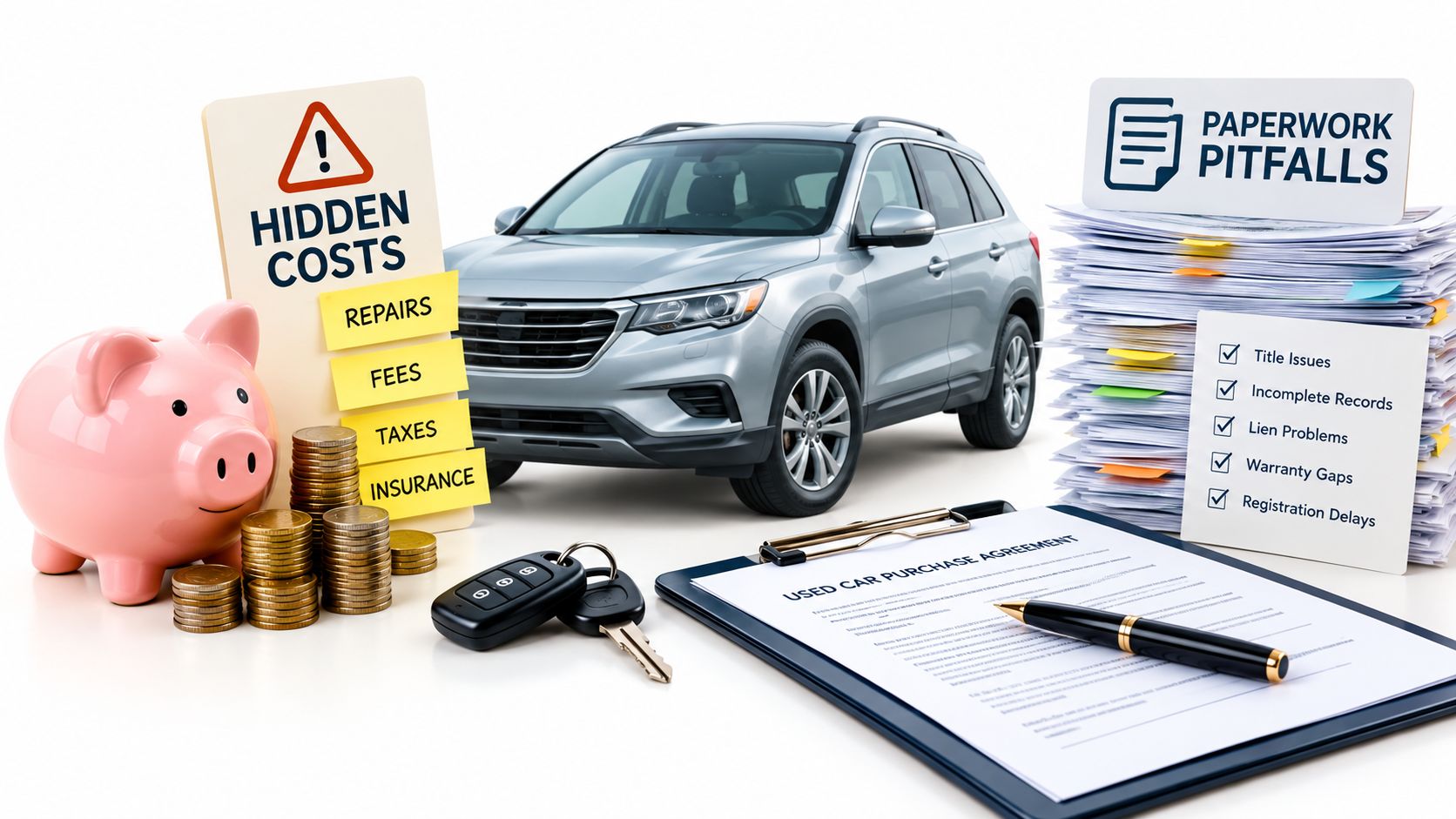
Used-car buyers often focus on the advertised price and monthly payment. Both can distract from the number that matters most, the out-the-door total. A vehicle advertised attractively may come with add-ons, certification charges, government fees, or administrative costs that weren’t clear at the start.
The Federal Trade Commission has described enforcement action involving an auto dealer group accused of charging consumers for costly add-ons they hadn’t agreed to pay for. The agency also alleged that a certified-used-car dealer regularly charged junk fees for certification, add-on products, and government charges without consent, in some cases costing buyers thousands of dollars. The FTC’s automotive industry enforcement information makes the risk clear without requiring shoppers to guess what a vague “market adjustment” or protection package includes.
Ask for the complete price before discussing payment
A serious buyer should request an itemized worksheet before accepting any financing discussion. Don’t let a low monthly payment conceal the vehicle price, fees, interest, trade value, or products added to the contract.
Use this checklist:
- Vehicle price: Confirm the advertised price matches the written buyer’s order.
- Certification charge: Ask what inspection or certification includes and whether you requested it.
- Optional products: Require every protection plan, service contract, accessory, and security product to be identified as optional.
- Government charges: Separate legitimate registration and title costs from dealer-created administrative fees.
- Trade value: Keep the trade-in allowance visible so it isn’t used to disguise a price change elsewhere.
- Final total: Compare the full amount due, not just the advertised price or monthly payment.
BBB complaint records from 2026 include reports involving delayed DMV submissions, repeated temporary plates, and unresolved titling problems. One complaint alleged that paperwork wasn’t filed by the legal deadline, while another described a buyer being stuck with a third temporary plate without permanent registration. The BBB complaint record for Atlas Motors illustrates why paperwork deserves the same scrutiny as the vehicle itself.
Treat temporary tags as an administrative warning
A temporary plate isn’t just an inconvenience. It can signal that the title transfer, lien documentation, or registration process hasn’t been completed correctly. Before financing closes, ask who submits the paperwork, what documents you’ll receive, and how the dealer handles delays.
Used-car supply pressure can make this problem worse. BCG reported that 34% of surveyed dealers considered used-vehicle supply a large or severe challenge, while 42% called it moderate. The same report said used-car retail sales rose 10% year over year in Q4 2024. BCG’s automotive dealer perspective shows why dealers are competing aggressively for inventory, but supply pressure isn’t a reason for you to accept unclear fees or incomplete paperwork.
Buying new doesn’t eliminate the need to read documents. It does give you a cleaner starting point. You aren’t trying to reconstruct a previous owner’s decisions, verify every prior repair, or determine whether the advertised certification justifies an added charge.
Evaluating New Jeep Capabilities Against Used Alternatives
A used Jeep can be the right purchase for a particular budget, but buyers shouldn’t compare a current model with an older one by badge alone. Compare the exact engine, output, body style, equipment, and capability. That is where the 2026 Jeep Grand Cherokee and 2026 Jeep Wrangler make a strong case for buying new.
Grand Cherokee power is defined before the test drive
The standard 3.6-liter V6 in the 2026 Grand Cherokee produces 293 horsepower and 260 lb-ft of torque. The available 2.0-liter turbocharged four-cylinder produces 324 horsepower and 332 lb-ft of torque. Both use an eight-speed automatic transmission, according to Kelley Blue Book’s 2026 Jeep Grand Cherokee specifications.
That distinction matters on Long Island. You can choose the output that fits your driving priorities instead of accepting whichever engine a used lot happens to have. The Grand Cherokee also lists a maximum towing capacity of 6,200 pounds and a 23-gallon fuel tank, giving buyers concrete capability figures to evaluate against their boat, trailer, or recreational equipment needs.
A used alternative may have similar numbers on paper, but its actual performance depends on maintenance, mileage, previous use, and whether the advertised vehicle has the correct package. New lets you start with a known configuration.
Wrangler body style changes daily practicality
The Wrangler decision begins with the doors. The 2-door Wrangler measures 166.8 inches in length, while the 4-door model measures 188.4 inches, according to Jeep’s Wrangler FAQ. With the available Xtreme 35-Inch Tire Package, those figures extend to 170.9 inches for the 2-door and 192.5 inches for the 4-door.
Those dimensions help shoppers evaluate garage fit, street parking, rear-seat access, and cargo priorities before they sign. A 2-door may suit a driver who values a shorter footprint and a more focused trail setup. A 4-door makes more sense for regular passengers, child seats, or gear that needs to stay inside the cabin.
The same FAQ identifies both a 6-speed manual and an 8-speed automatic transmission. That choice is meaningful, not decorative. Buyers who want direct control can seek the manual configuration, while commuters dealing with Long Island traffic may prefer the automatic.
A new Wrangler gives you control over the configuration. A used Wrangler gives you a search result that may or may not match your priorities.
That’s the central difference. New Jeep capability isn’t just about maximum output. It’s about knowing precisely what you’re buying and selecting the body style, engine, transmission, and package before the vehicle becomes yours.
Selecting the Right RAM and Durango for Your Lifestyle
The right new vehicle depends on what you carry, who rides with you, and how often you need truck utility. Don’t choose a RAM 1500 because it looks capable, and don’t choose a Durango because it has an appealing profile. Start with the jobs the vehicle must perform on ordinary weekdays and occasional weekends.
Choose the RAM 1500 around the work it must do
The RAM 1500 Big Horn and Lone Star deserve a practical comparison, not a badge-based one. Consider whether you need an open bed for equipment, home projects, outdoor gear, or materials that shouldn’t occupy the cabin. Then decide which configuration and available equipment fit your budget, parking situation, and towing needs.
A buyer commuting through Amityville may value a truck that handles daily driving comfortably while still providing bed utility. Someone regularly hauling gear toward the Hamptons should focus on the exact truck configuration and its documented capability, rather than assuming every RAM 1500 performs identically. Ask for the specific equipment list and confirm the vehicle is set up for the work you do.
Choose the Durango around people and cargo
The Dodge Durango is the more natural fit for buyers who need SUV practicality without moving to a pickup. It suits families, drivers carrying passengers and sports equipment, and shoppers who want a substantial vehicle for road trips and everyday errands.
The Grand Cherokee provides another clear reference point. Jeep lists the standard model with 2-row seating for five passengers, while the 3-row Grand Cherokee L Summit seats up to seven. Jeep’s FAQ also lists a 6,050-pound gross vehicle weight rating for the 2026 Grand Cherokee. Jeep’s Grand Cherokee FAQ gives the specifications buyers should use when separating the standard model from the longer three-row version.
Use this decision filter:
- Count regular passengers. If five seats cover your normal needs, a 2-row SUV may be the cleaner choice. If your household regularly carries more people, examine the three-row Grand Cherokee L or Durango.
- Measure cargo habits. Strollers, tools, sports equipment, and luggage can change the decision more than exterior styling.
- Separate occasional needs from daily needs. Don’t buy a truck for rare hauling if an SUV handles your routine better. Don’t buy a two-row vehicle if you constantly need another row.
- Confirm the exact configuration. Engine, transmission, seating, packages, and ratings should come from the vehicle’s documentation.
For shoppers in Massapequa, Lindenhurst, or Farmingdale, this process prevents an expensive mismatch. Buy the vehicle that fits your life, not the vehicle with the loudest sales pitch.
The Advantage of Buying New from a Trusted Local Dealership
A local purchase makes sense when the dealership serves the places where you drive. Amityville sits near Copiague, Lindenhurst, Massapequa, and Farmingdale, creating a practical local reach for shoppers who don’t want to spend a day crossing Long Island to chase an uncertain used-car deal.
Security Dodge Chrysler Jeep RAM of Amityville offers new Jeep, Dodge, and RAM vehicles alongside pre-owned and certified inventory, financing, rentals, and service options. For this decision, the important point is the new-vehicle selection. You can compare the Grand Cherokee, Wrangler, RAM 1500 Big Horn, RAM 1500 Lone Star, and Durango through a dealership focused on those brands instead of sorting through unrelated used inventory.
Local convenience improves the buying process
A nearby showroom makes it easier to complete the parts of a new purchase that online listings can’t replace. You can sit in both Wrangler body styles, evaluate Grand Cherokee seating, compare truck access, and ask direct questions about available configurations. You can also bring your trade-in and discuss financing in one place.
A transparent conversation should include:
- The exact vehicle: Confirm model, trim, engine, transmission, and equipment.
- The complete price: Ask for an itemized out-the-door figure.
- Your trade: Keep its value separate from the new vehicle price.
- The payment structure: Review the amount financed, term, and total obligation.
- Availability: Verify that the displayed vehicle is available for a test drive.
Buying local doesn’t mean accepting a vague process. It means choosing a location where the transaction is convenient enough for you to ask better questions and take the vehicle home with fewer unknowns. That advantage is especially valuable when you’re choosing among several distinct Jeep, RAM, and Dodge models rather than hunting for the lowest advertised price.
Making Your Final Decision with Confidence
The new-versus-used decision becomes straightforward once you stop treating the sticker price as the entire deal. Used cars dealers may offer appealing listings, but buyers must account for fee clarity, paperwork reliability, vehicle-specific condition, and whether the configuration matches the intended use.
New Jeep and RAM models deserve serious consideration because they put the decision in your hands. You can select the Grand Cherokee engine, choose between Wrangler body styles, compare the RAM 1500 Big Horn and Lone Star, or decide whether the Durango better fits your passenger and cargo needs. The price is only one part of the value. Defined specifications and a clear buying process matter just as much.
Use this showroom checklist
Before you commit, ask yourself:
- Does the vehicle fit the job? Confirm passenger capacity, cargo needs, towing expectations, and daily driving habits.
- Do you know the exact specifications? Verify the engine, transmission, body length, seating layout, and included packages.
- Is the price complete? Request an itemized out-the-door total and question every optional product.
- Is your trade-in separated? Make sure its value isn’t hiding a change in the new vehicle price.
- Have you tested the practical details? Sit in every row, check cargo access, assess visibility, and evaluate parking comfort.
- Are you comparing like for like? A used vehicle with a lower price isn’t a fair alternative if it has different equipment, condition, or capability.
The strongest recommendation for Long Island buyers is direct. Don’t reject new vehicles just because used cars sound cheaper. Compare the total transaction, the actual configuration, and the amount of uncertainty attached to each option. For many shoppers near Amityville, a new Grand Cherokee, Wrangler, RAM 1500, or Durango offers a more controlled and sensible purchase than chasing a pre-owned bargain that may lose its advantage through fees, delays, or mismatched equipment.
Security Dodge Chrysler Jeep RAM offers new Jeep, RAM, and Dodge vehicles, including the Grand Cherokee, Wrangler, RAM 1500, and Durango, for Long Island shoppers comparing new capability with used-car uncertainty. Visit Security Dodge Chrysler Jeep RAM in the Amityville area to compare configurations, review pricing, and arrange a test drive.
0 comment(s) so far on Used Cars Dealers vs New Car Dealers | Jeep and RAM Models